

Subfamily Polyzosteriinae
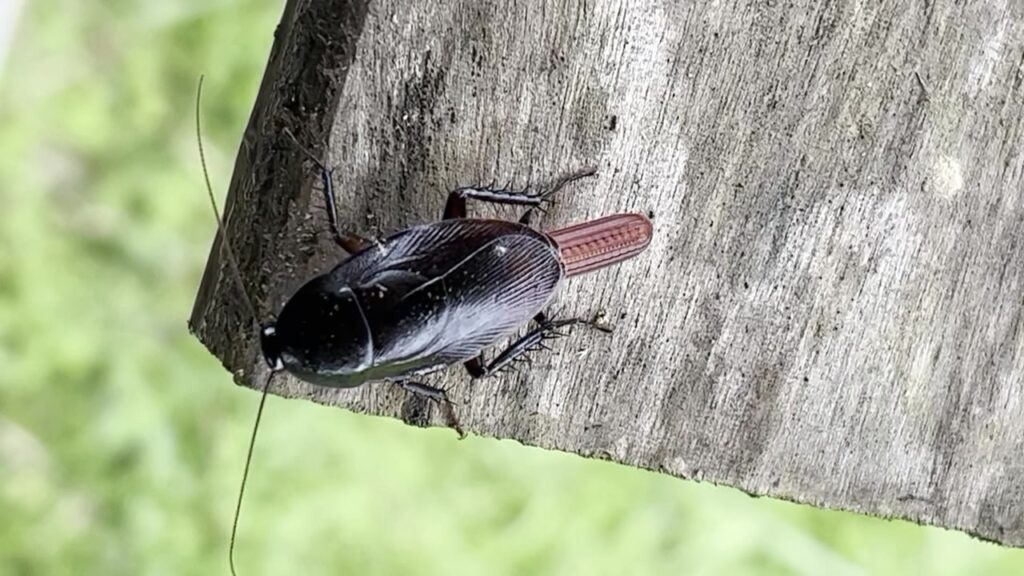
Polyzosteriinae is a distinctive subfamily of cockroaches within the family Blattidae and order Blattodea. Members are commonly known as wood cockroaches or bark cockroaches and are particularly characteristic of Australia and surrounding regions. Unlike many familiar household cockroaches, polyzosteriines are primarily wild, ground-dwelling insects associated with forests, woodland, leaf litter, and other natural habitats.
Polyzosteriines are generally medium-sized, robust, and strongly flattened cockroaches. Their bodies are often oval to broadly elongate, with the head partly concealed beneath the pronotum. Many species have dark brown, reddish-brown, black, or nearly black coloration, sometimes combined with yellow, orange, or pale bands and margins. The hard, compact appearance of the body provides protection while moving through leaf litter and beneath bark.
A particularly notable characteristic is the reduction or absence of functional wings in many species. This distinguishes numerous polyzosteriines from the long-winged cockroaches commonly encountered around buildings. Wing reduction is particularly associated with their largely terrestrial lifestyle, in which rapid running and maneuvering through ground-level vegetation are more important than flight.
The pronotum is often broad and strongly developed, forming a shield over the head. The antennae are relatively long and provide sensory information about odors, contact, humidity, and nearby objects. Their legs are adapted for terrestrial movement and commonly bear spines that assist in traction and rapid escape.
Most Polyzosteriinae are nocturnal or crepuscular, although individuals may occasionally be encountered during daylight, particularly when shelters are disturbed. They spend much of the day concealed beneath stones, bark, logs, leaf litter, or other debris. Their flattened bodies allow them to exploit narrow spaces in the forest floor and under loose bark.
Feeding is generally omnivorous and detritivorous. They consume decomposing leaves, plant fragments, fungi, fruits, seeds, and other organic material. Some species may also consume animal-derived material or carrion when available. This broad diet enables them to exploit the diverse organic resources found in woodland and forest-floor environments.
As consumers of decomposing vegetation, polyzosteriines contribute to decomposition and nutrient cycling. Their feeding and movement fragment organic material and help redistribute nutrients within the litter layer. They are also an important source of food for predators including birds, reptiles, amphibians, spiders, predatory insects, and small mammals.
Reproduction follows the typical cockroach pattern of producing an ootheca, a protective egg case containing multiple eggs. Females deposit the ootheca in a sheltered environment suitable for embryonic development. The young emerge as nymphs and undergo a series of molts before reaching adulthood. In many species, development is closely linked to seasonal temperature and moisture conditions.
The subfamily is particularly diverse in Australia, where members occur across a wide range of habitats. They can be found in temperate forests, eucalyptus woodland, coastal vegetation, shrublands, dry woodland, and other terrestrial ecosystems. Related forms occur in nearby regions of the Australasian biogeographic area, reflecting the evolutionary history of the group.
Important genera associated with Polyzosteriinae include Polyzosteria and several other Australian lineages traditionally placed within the subfamily. Polyzosteria contains some of the best-known representatives and illustrates the group’s characteristic combination of a strongly armored-looking body, reduced wings, and terrestrial habits. The exact generic composition and higher classification can vary between taxonomic treatments.
Unlike major pest cockroaches such as Periplaneta and Blattella, polyzosteriines are not primarily household pests. Their association with natural habitats means that encounters with humans are generally incidental. Some species may enter gardens or other disturbed environments, but they are fundamentally components of native terrestrial ecosystems.
Polyzosteriines also show adaptations suited to survival in seasonally variable environments. Their protected body form, cryptic coloration, and tendency to remain within sheltered microhabitats help reduce exposure to predators and unfavorable conditions. In dry environments, access to humid refuges such as leaf litter, soil crevices, and decaying wood can be particularly important.
From a taxonomic perspective, Polyzosteriinae is part of the broader Blattidae–Blattoidea lineage, although cockroach classification has undergone considerable revision with the incorporation of molecular phylogenetic evidence. Some historical classifications have treated particular Australian cockroach groups differently, so genus and species assignments may vary among modern databases and taxonomic authorities.
Overall, Polyzosteriinae is a distinctive subfamily of predominantly Australian terrestrial cockroaches characterized by robust flattened bodies, frequent wing reduction, cryptic coloration, and strong associations with leaf litter, woodland, and forest-floor habitats. Rather than being chiefly associated with human dwellings, these cockroaches are important native decomposers and prey organisms within Australasian terrestrial ecosystems.