

Genus Melanozosteria
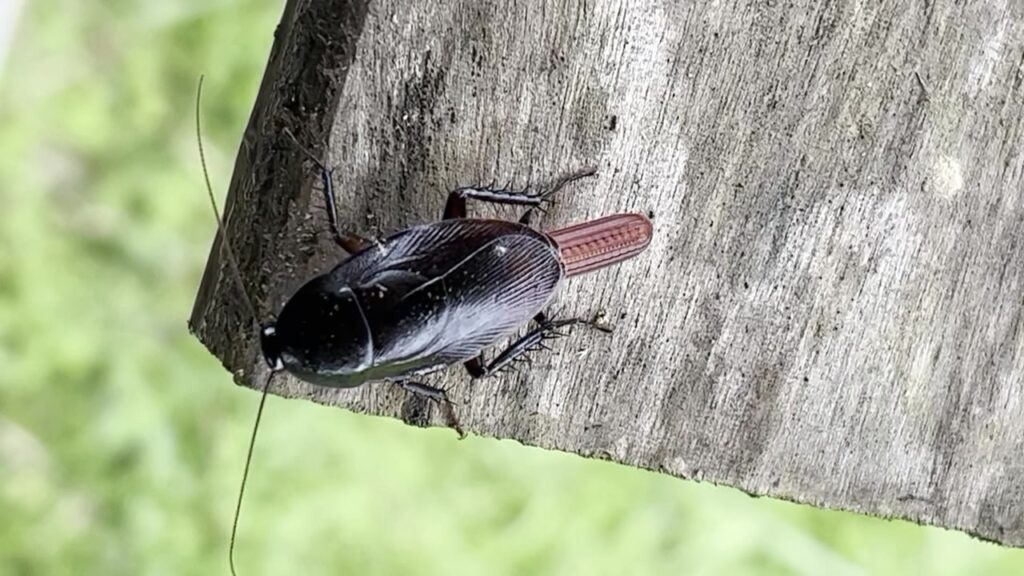
Melanozosteria is a genus of cockroaches in the family Blattidae, subfamily Polyzosteriinae, and tribe Polyzosteriini. It is a predominantly Australian lineage of flightless or strongly wing-reduced cockroaches, characterized by robust, flattened bodies and a terrestrial lifestyle. Unlike the better-known synanthropic cockroaches of Periplaneta, species of Melanozosteria are primarily associated with natural environments such as woodland, forest, leaf litter, and sheltered ground habitats.
Members of Melanozosteria are generally medium-sized to large, compact, and strongly flattened. The body is usually broad and oval, with a prominent pronotum covering much of the head. The surface can be smooth and relatively glossy in some species, while coloration varies from dark reddish brown and chestnut to very dark brown or nearly black. Species can also exhibit contrasting pale or yellowish markings along the abdominal margins.
A defining characteristic of the genus is its greatly reduced wings. Adult males and females generally have only vestigial tegmina, with the hind wings absent. Consequently, Melanozosteria species are essentially flightless and depend on walking rather than aerial dispersal. This morphology is characteristic of the broader Polyzosteriinae, in which wing reduction or complete winglessness is widespread.
The flattened body and reduced wings are well suited to a ground-dwelling lifestyle. Individuals can move through leaf litter, beneath bark, under stones, and among fallen vegetation, where a compact body helps them exploit narrow shelters. The hardened body surface and dark coloration also provide protection and camouflage in the litter layer and beneath woody debris.
Like other polyzosteriine cockroaches, Melanozosteria is primarily associated with terrestrial habitats in Australia. The genus is predominantly Australian in distribution, although M. nitida has also been documented from Guangxi in southern China. The genus therefore demonstrates a broader Australasian–Southeast Asian distribution than many strictly Australian polyzosteriine lineages.
Activity is generally associated with sheltered, humid microhabitats, particularly conditions beneath vegetation, bark, stones, and accumulated organic debris. The absence of functional wings indicates that movement is largely terrestrial and that local habitat structure is especially important for dispersal. Seasonal temperature and moisture conditions are likely to influence activity, reproduction, and population abundance.
Feeding is expected to be primarily detritivorous and omnivorous, consistent with the ecology of Polyzosteriinae. These cockroaches consume decomposing plant material and other organic matter available within the litter layer. Such feeding habits place Melanozosteria within the detrital food web, where it can contribute to fragmentation and redistribution of organic material.
Reproduction follows the general cockroach pattern of ootheca production. Females produce protective egg cases containing multiple eggs, from which wingless nymphs emerge. The nymphs resemble small versions of the adults and undergo a series of molts before reaching maturity. In a flightless lineage such as Melanozosteria, reproductive sites and sheltered microhabitats are particularly important for maintaining local populations.
The genus has a substantial species diversity. A modern review cited 44 known species of Melanozosteria and noted that most are distributed in Australia. Australian biodiversity databases currently recognize numerous species, including M. aculeata, M. aterrima, M. atra, M. ayrensis, M. balteata, M. barrominensis, M. bicolor, M. capitolina, M. castanea, M. ceratodi, M. glabra, and M. dookiensis, among others.
Several species have a history of taxonomic reclassification. The genus was established by Stål in 1874, and Melanozosteria was subsequently treated at different times as a synonym or subgenus within Platyzosteria. Roth re-established it as a distinct genus in 2003, a treatment followed by modern Australian taxonomic resources.
The genus is ecologically significant as part of the native Australian cockroach fauna. Its members contribute to the processing of dead vegetation and other organic material while serving as prey for reptiles, amphibians, birds, spiders, and predatory arthropods. Their flightless condition and association with particular habitats also make them useful examples of terrestrial specialization within Blattodea.
Overall, Melanozosteria is a distinctive genus of predominantly Australian, flightless polyzosteriine cockroaches characterized by strongly flattened bodies, reduced wing structures, dark and often glossy coloration, and a close association with terrestrial litter and sheltered habitats. Its extensive species diversity and unusual wingless morphology make it an important component of the evolutionary and ecological diversity of Australian Blattidae.