

Pygmy Grasshoppers (Family Tetrigidae)
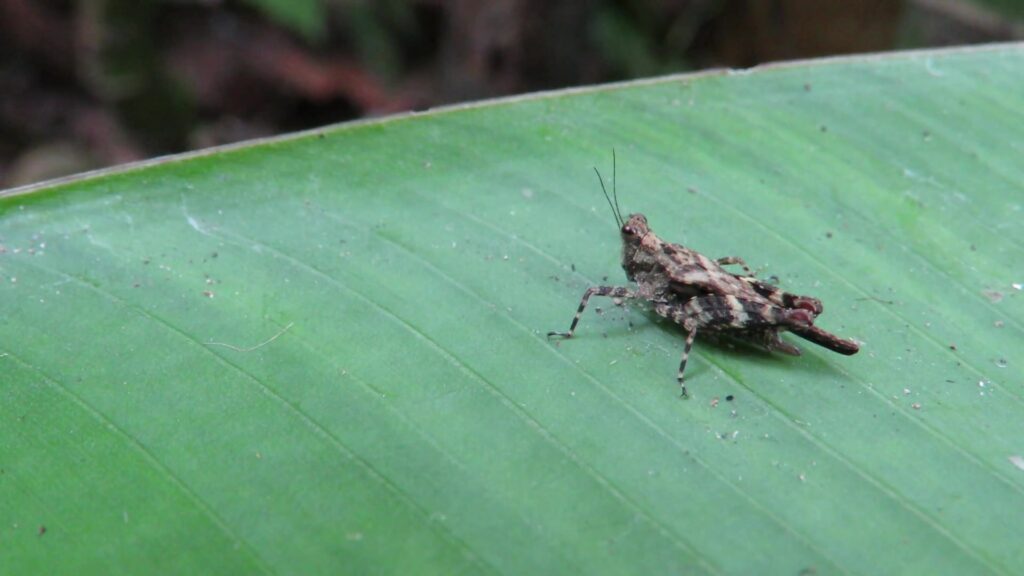
The family Tetrigidae, commonly known as pygmy grasshoppers, groundhoppers, or grouse locusts, is a diverse group of small insects belonging to the order Orthoptera, suborder Caelifera, and superfamily Tetrigoidea. These insects are characterized by their compact bodies, short antennae, powerful hind legs, and an enlarged pronotum that typically extends backward over much of the abdomen. They are distributed throughout tropical, subtropical, and temperate regions, where they inhabit forests, wetlands, grasslands, stream margins, and other environments with suitable ground-level vegetation.
Tetrigids are generally small, commonly measuring around 5–20 millimeters in body length, although their size varies among species. Their most distinctive anatomical feature is the elongated pronotum, a hardened plate behind the head that often forms a pointed projection covering much of the body. Their coloration usually consists of brown, gray, black, or green patterns that resemble soil, stones, moss, bark, and dead leaves. This camouflage helps them remain concealed from predators in their natural surroundings.
The family exhibits considerable variation in wing development. In many species, the forewings are reduced to small, scale-like structures, while the hindwings may be well developed and concealed beneath the pronotum. Other species have reduced wings and limited flight ability. Their strong hind legs allow them to leap quickly when disturbed, often disappearing into leaf litter, low vegetation, crevices, or shallow water.
Tetrigidae has a broad geographic distribution, occurring in Asia, Africa, Europe, the Americas, and numerous islands. Many species are associated with moist habitats such as riverbanks, marshes, damp forest floors, moss-covered rocks, and muddy stream margins. Others inhabit grasslands, open woodland, rocky slopes, and comparatively dry environments. Local moisture, substrate conditions, and the availability of suitable food often determine where particular species occur.
Most tetrigids feed on algae, mosses, lichens, and delicate plant material, although some species also consume seedlings, decaying vegetation, and other organic matter. Their feeding habits differ from those of many larger grasshoppers, which frequently consume substantial quantities of grasses and broad-leaved plants. By feeding on low-growing organisms, tetrigids contribute to nutrient cycling and energy transfer within ground-level ecosystems.
These insects are generally active during daylight, although their activity depends on temperature, humidity, and local environmental conditions. Many remain motionless when approached, relying on their cryptic coloration to avoid detection. When threatened, they may suddenly leap into nearby vegetation or leaf litter. Some species inhabit the edges of streams and wetlands and may enter water as an escape response.
Reproduction follows the typical grasshopper pattern of incomplete metamorphosis. Females deposit eggs in soil or other suitable substrates, and the emerging nymphs resemble smaller, wingless versions of the adults. They grow through several molts before reaching maturity. Developmental rates and reproductive timing vary according to species, climate, moisture, and food availability, with seasonal patterns in temperate regions and rainfall-related activity in many tropical habitats.
Representative genera include Tetrix, Tetrigidea, Paratettix, Euparatettix, and Criotettix. These genera display variation in body proportions, pronotum shape, wing development, and habitat preferences. Identifying individual species can be challenging because many share similar coloration and overall appearance, so taxonomists often examine detailed anatomical characteristics.
Tetrigids play a role in terrestrial food webs as consumers of algae, mosses, and other small plant-associated organisms. They provide food for spiders, predatory insects, amphibians, reptiles, birds, and other small predators. Species living near streams and wetlands may also contribute to assessments of local habitat diversity, although their presence alone does not establish the overall health of an ecosystem.
Although pygmy grasshoppers are generally not major agricultural pests, their populations can be affected by wetland drainage, stream modification, pollution, forest clearance, habitat fragmentation, and changes in local moisture conditions. Species with restricted distributions or specialized habitat requirements may be especially vulnerable to environmental disturbance.
Overall, the family Tetrigidae represents a distinctive lineage of small, ground-dwelling grasshoppers adapted to diverse terrestrial microhabitats. Their elongated pronotum, effective camouflage, jumping ability, and varied feeding habits distinguish them from many other orthopterans, while their ecological relationships make them a valuable component of the biodiversity of forests, wetlands, and grasslands.