

Leafwing Butterflies (Subfamily Charaxinae)
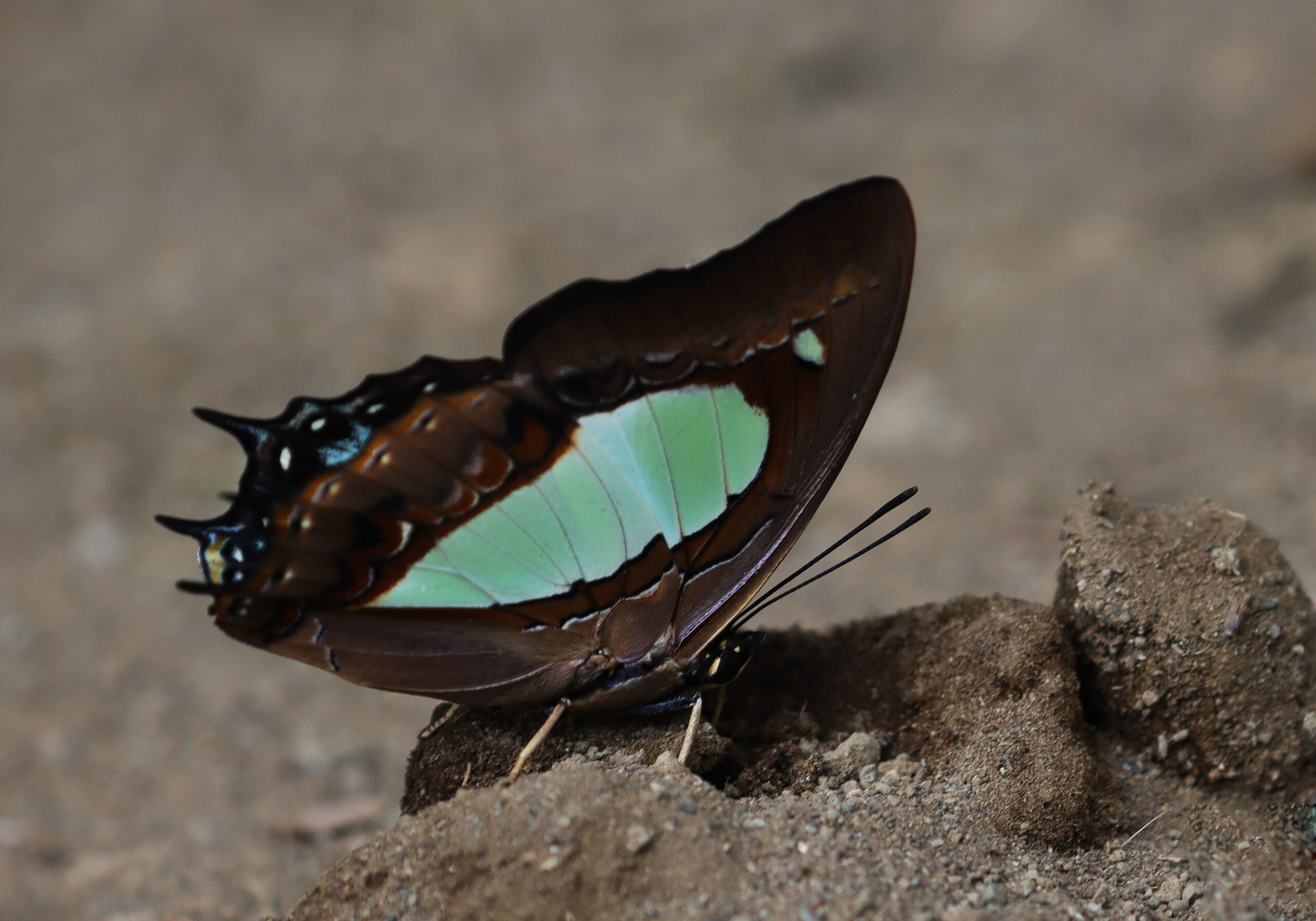
Charaxinae is a subfamily of brush-footed butterflies within the family Nymphalidae (Superfamily Papilionoidea, Order Lepidoptera). Commonly known as the rajahs, nawabs, emperors, and leaf butterflies, the subfamily comprises more than 400 described species distributed throughout tropical and subtropical regions of Africa, Asia, Australia, and the Americas. Members are especially diverse in tropical rainforests, where they inhabit forest interiors, woodland edges, river valleys, mangroves, secondary forests, and occasionally plantations, parks, and gardens.
Butterflies of the subfamily Charaxinae are generally medium to very large in size and are characterized by their robust body, broad forewings, and often angular or tailed hindwings. Like all members of the family Nymphalidae, they possess reduced, brush-like forelegs that are not used for walking. Wing coloration is highly variable, ranging from vivid orange, blue, green, yellow, white, and black to cryptic shades of brown and gray. Many species have boldly patterned upper surfaces, while the undersides closely resemble dead leaves, bark, or dried foliage, providing excellent camouflage when the wings are closed.
Adults are diurnal and are among the strongest fliers of all butterflies, capable of rapid, powerful, and sustained flight through forest canopies and open clearings. Unlike many butterflies that primarily visit flowers, numerous Charaxinae species feed preferentially on fermenting fruits, tree sap, animal dung, carrion, and mineral-rich moisture, although some also take nectar. Males commonly engage in mud-puddling, gathering on damp soil or stream banks to obtain essential minerals for reproduction.
The life cycle involves complete metamorphosis, consisting of egg, larva (caterpillar), pupa (chrysalis), and adult stages. Females usually lay eggs singly on the leaves of host plants. Caterpillars are typically smooth-bodied and possess distinctive horn-like projections on the head or body, providing camouflage among foliage. They feed on a wide variety of trees, shrubs, and woody vines, depending on the species. Pupation occurs on leaves, twigs, or stems, where the chrysalis is attached by a silken girdle or suspended from a cremaster.
The subfamily includes several prominent genera, such as Charaxes, Polyura, Euxanthe, Anaea, Memphis, Prepona, and Agrias. Many species are renowned for their brilliant coloration, remarkable speed, territorial behavior, and exceptional adaptations for camouflage and mimicry.
Ecologically, Charaxinae butterflies play important roles in forest ecosystems as pollinators and nutrient recyclers, particularly through feeding on fermenting fruits and tree sap. Their caterpillars contribute to plant–herbivore interactions, while both larvae and adults serve as prey for birds, reptiles, spiders, predatory insects, and parasitoids. Their close association with mature forests and specific host plants makes many Charaxinae species valuable indicators of forest health, habitat integrity, and biodiversity.