

Asota heliconia
Asota heliconia is a species of tiger moth belonging to the genus Asota (Subfamily Aganainae, Family Erebidae, Superfamily Noctuoidea, Order Lepidoptera). It is widely distributed throughout South Asia, Southeast Asia, southern China, Taiwan, and the Indo-Australian region. The species inhabits tropical rainforests, secondary forests, mangroves, woodland edges, plantations, parks, gardens, and other habitats with abundant woody vegetation. Adults are frequently observed around flowering plants and are readily attracted to artificial lights at night.
Asota heliconia is a medium-sized moth with a wingspan of approximately 50–70 mm. It has a slender but robust body and broad wings that display a striking pattern of contrasting colors. The forewings are typically dark brown to black with conspicuous white patches or bands, while the hindwings are bright orange to yellow-orange with a broad black outer margin. The abdomen is usually orange with black markings, and the thorax is dark with contrasting pale spots. These bold color patterns function as aposematic (warning) coloration, signaling potential unpalatability to predators.
Adults are primarily nocturnal, although they may occasionally become active during the late afternoon or at dusk. They rest on foliage or tree trunks during the day and become active after sunset, flying swiftly in search of nectar sources and mates. Adults possess a well-developed coiled proboscis and feed mainly on nectar, while they may also visit tree sap and fermenting fruits. They are commonly attracted to artificial lights, making them frequently encountered during nocturnal surveys.
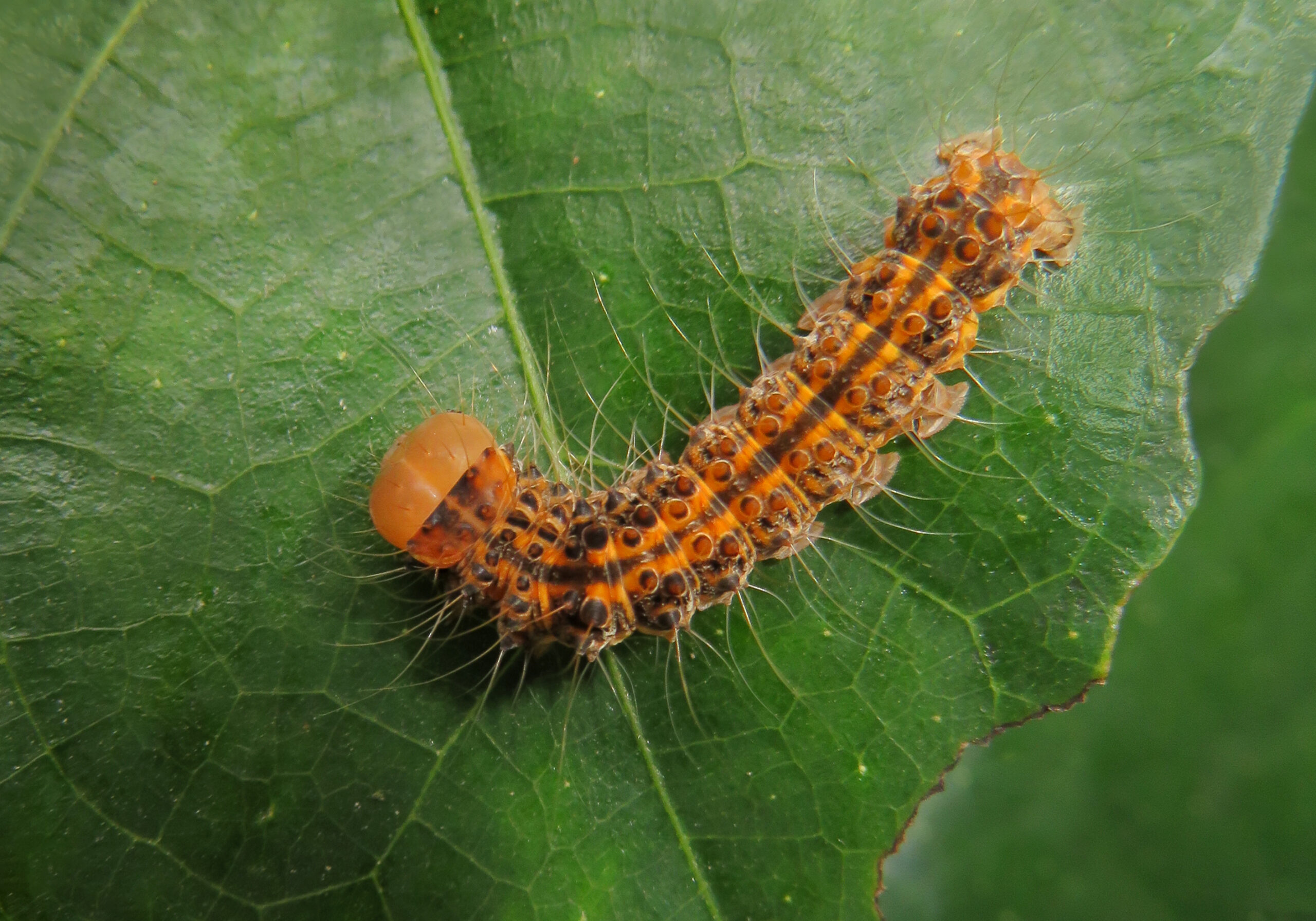
The life cycle involves complete metamorphosis, consisting of egg, larva (caterpillar), pupa, and adult stages. Females lay eggs in clusters on the leaves of host plants. The caterpillars are smooth-bodied, dark gray to black with longitudinal yellow or orange markings and sparse hairs. They feed primarily on species of Ficus (family Moraceae), although related host plants may also be utilized. After completing larval development, the caterpillar pupates within a loose silken cocoon among leaves or leaf litter before emerging as an adult.
Asota heliconia is one of the more conspicuous members of its genus because of its bright hindwings and contrasting forewing pattern. Its wide distribution and adaptability allow it to thrive in both natural forests and human-modified landscapes where host plants remain available.
Ecologically, Asota heliconia contributes to forest and woodland ecosystems as a herbivore during the larval stage and as a nocturnal pollinator during adulthood. The caterpillars participate in plant–herbivore interactions, while both larvae and adults serve as prey for birds, bats, reptiles, spiders, predatory insects, and parasitoid wasps. Because it is associated with healthy woody vegetation and native host plants, Asota heliconia is considered a useful indicator of habitat quality and tropical forest biodiversity.