

Reticulated Python (Malayopython reticulatus)
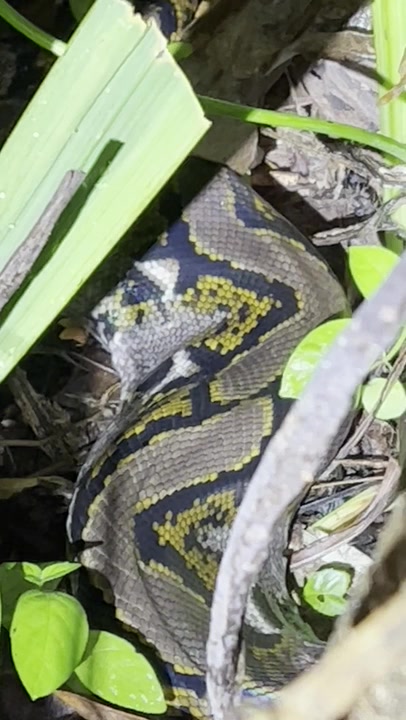
Malayopython reticulatus, commonly known as the Reticulated Python or Reticulated Python (sanca batik), is a giant nonvenomous constricting snake in the family Pythonidae. It is one of the most widely distributed large pythons in Southeast Asia and is renowned for its exceptional length, intricate net-like coloration, powerful musculature, and adaptability to both natural and human-modified habitats. The species is currently placed in Malayopython, a genus containing two recognized species.
The Reticulated Python has a long, muscular, cylindrical body and a relatively large head that is distinct from the neck. It is one of the longest living snakes, with exceptional individuals reported at lengths approaching or exceeding 7 m, although such giants are uncommon. The species has a high midbody scale count and the characteristic thermoreceptive labial pits of Malayopython, which help distinguish it from related python genera.
Its name refers to its spectacular reticulated color pattern. The dorsal surface is typically marked by an intricate network of dark lines enclosing lighter, often golden, tan, brown, or gray areas. Additional dark blotches and geometric markings create a complex pattern that breaks up the snake’s outline among vegetation, leaf litter, branches, and shaded forest floors. The precise appearance varies geographically and among recognized subspecies.
The head is usually patterned with dark and pale markings, while the lips contain rows of heat-sensitive sensory pits. These infrared-sensitive organs allow the snake to detect the body heat of potential prey, particularly in darkness. Combined with its highly developed sense of smell and chemical sensing through the forked tongue and vomeronasal organ, this sensory system makes M. reticulatus an effective predator under low-light conditions.
The species is an ambush predator and powerful constrictor. After seizing prey with numerous sharp, backward-pointing teeth, it rapidly throws several coils around the victim. Muscular constriction prevents effective circulation and breathing, after which the prey is swallowed whole. Its extremely flexible skull and ligaments allow it to consume animals considerably wider than its head.
The diet changes with body size and habitat. Young Reticulated Pythons commonly take small mammals, birds, reptiles, and other vertebrates, whereas large adults can capture substantial mammals and birds. The species is an opportunistic predator and has been documented taking a wide variety of prey. Its ability to exploit both terrestrial and aquatic environments broadens the range of potential prey available to it.
Despite its enormous potential size, M. reticulatus is an excellent swimmer and capable climber. It occurs in tropical forests, swamps, wetlands, mangroves, plantations, agricultural landscapes, and areas surrounding human settlements. It is often associated with water and humid environments but can also travel considerable distances over land. The species is partly arboreal, particularly when younger or where suitable vegetation provides access to prey.
Its geographic range is extensive, extending across South and Southeast Asia and the Indonesian and Philippine archipelagos. Confirmed records include Bangladesh, Myanmar, Thailand, Laos, Cambodia, Vietnam, Malaysia, Brunei, Singapore, the Philippines, and a very large number of islands in Indonesia and Timor-Leste. Some historical mainland records, particularly from India, remain questionable.
Reproduction is oviparous. Females lay a clutch of relatively large eggs in a protected location and may coil around them during incubation. Maternal coiling provides physical protection and allows the female to influence the thermal environment of the clutch through behavioral thermoregulation. Hatchlings emerge as fully formed miniature snakes and become independent shortly afterward.
The species is generally solitary, except during breeding or when individuals converge on abundant food or suitable habitat. Adults spend considerable periods resting after consuming large meals, during which digestion can be energetically demanding. Activity is often concentrated during evening and nighttime, although individuals may also move during daylight under suitable environmental conditions.
The Reticulated Python is an important large vertebrate predator within tropical Asian ecosystems. By consuming mammals, birds, reptiles, and other vertebrates, it influences prey populations and transfers energy between trophic levels. Juveniles are themselves vulnerable to predation by larger predators, while large adults have relatively few natural enemies apart from humans.
The species is also one of the pythons most frequently encountered in human-dominated landscapes. It can persist around farms, plantations, villages, drainage channels, and urban fringes where prey and shelter are available. This adaptability sometimes results in conflicts when large individuals prey upon poultry, livestock, or domestic animals, although the species also consumes rodents and other animals that may be considered pests.
Three subspecies are currently listed by The Reptile Database: Malayopython reticulatus reticulatus, M. r. saputrai, and M. r. jampeanus. The latter two are associated with Indonesian islands, while M. r. reticulatus has the broadest distribution. The taxonomy of the species has changed considerably over time, with historical combinations including Python reticulatus and Broghammerus reticulatus before its current placement in Malayopython.
Despite its adaptability, M. reticulatus faces pressures from commercial exploitation, particularly for its skin, as well as habitat loss, persecution, road mortality, and collection. The species has historically been heavily represented in the international reptile-skin trade; wild individuals from Indonesia and Malaysia have been exported in large numbers.
Overall, Malayopython reticulatus is one of the world’s most remarkable snakes, combining enormous potential body length with exceptional swimming and climbing abilities, sophisticated heat-sensing organs, powerful constriction, and a highly distinctive reticulated pattern. Its broad ecological tolerance has allowed it to persist across an extraordinary variety of Southeast Asian habitats, from tropical forests and wetlands to plantations and densely settled landscapes.