

Common Wolf Snake (Lycodon capucinus)
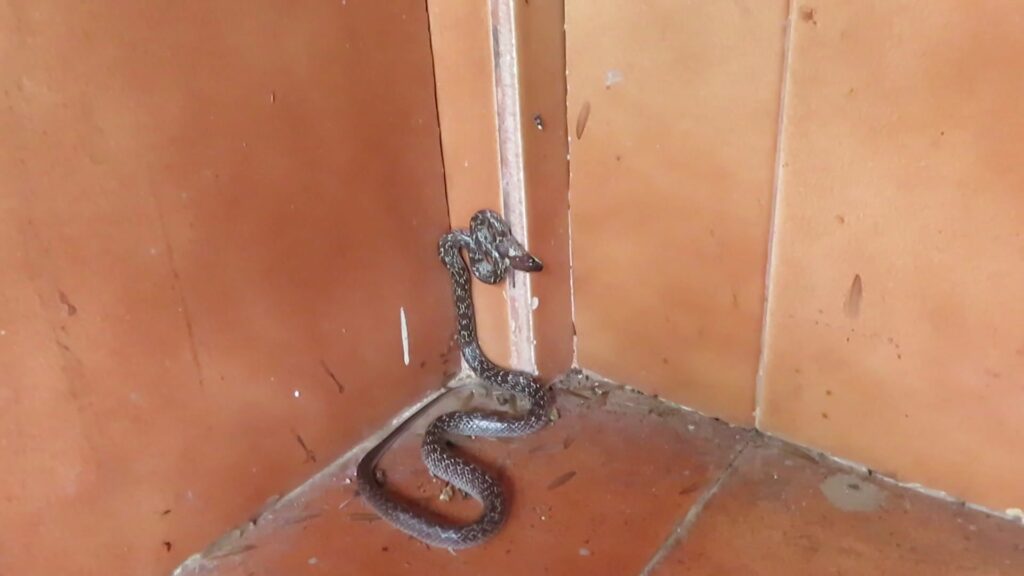
Lycodon capucinus, commonly known as the common wolf snake or common Asian wolf snake, is a species of nonvenomous snake belonging to the family Colubridae. It is widely distributed across South and Southeast Asia and is particularly well adapted to environments where small lizards and other prey are abundant. The species belongs to the genus Lycodon, whose members are known for their enlarged front teeth and often dark-colored bodies with pale markings.
This species has a slender, elongated body, a relatively distinct head, smooth scales, and a tapering tail. Its coloration is usually dark brown to black, with pale cream or whitish markings that may form irregular bands or crossbars along the body. The head is often dark, while the lips and parts of the underside may have lighter coloration. Its appearance can vary between individuals and geographic populations, and the banding pattern may become less distinct toward the tail.
Lycodon capucinus occurs across a broad region of South and Southeast Asia, including parts of the Indian subcontinent, mainland Southeast Asia, and numerous islands of the Indo-Malayan region. It inhabits tropical forests, secondary woodland, plantations, gardens, agricultural areas, and residential neighborhoods. Its ability to tolerate disturbed habitats allows it to live close to human settlements, where suitable shelter and prey are readily available.
The common wolf snake is primarily nocturnal, becoming active after sunset and remaining concealed during much of the day. It shelters beneath rocks, fallen logs, leaf litter, loose bark, and other objects that provide protection from predators and extreme environmental conditions. It may also enter buildings, especially where geckos and other small lizards are common. Its secretive behavior and dark coloration often make it difficult to notice.
Its diet consists mainly of small reptiles, particularly geckos and skinks. It may hunt along walls, around buildings, beneath vegetation, and in other places where lizards hide or forage. The snake uses its teeth to grasp and hold prey, and its flexible body allows it to move through narrow spaces while searching for food. By consuming small reptiles, it contributes to the regulation of prey populations within its habitat.
Although Lycodon capucinus is nonvenomous and is not considered medically significant to humans, it may bite defensively if captured or handled. It can sometimes be mistaken for venomous kraits because of its dark body and pale bands. However, wolf snakes and kraits differ in several anatomical characteristics. Wild snakes should not be handled based on appearance alone, and identification should be left to experienced observers when uncertainty exists.
Reproduction is oviparous, meaning that females lay eggs. Eggs are deposited in sheltered locations that provide suitable conditions for development. The young hatch as small, independently living snakes with coloration and markings resembling those of adults. Details of breeding behavior, clutch size, and reproductive timing may vary across the species’ extensive geographic range.
Ecologically, Lycodon capucinus is an adaptable predator that can persist in both natural and human-modified environments. It may be preyed upon by larger snakes, birds, and other predators. Despite its ecological value, it can be killed by people who mistake it for a dangerous venomous snake. Habitat alteration, road mortality, and persecution can also affect local populations.
Overall, Lycodon capucinus is a widespread, nocturnal wolf snake recognized by its slender body, dark coloration, pale markings, and preference for small reptilian prey. Its adaptability enables it to inhabit a variety of environments, including gardens and settlements. As a natural predator of geckos and other small lizards, it forms part of the ecological balance of the tropical and subtropical regions in which it occurs.