

Golden Orbweavers (Family Nephilidae)
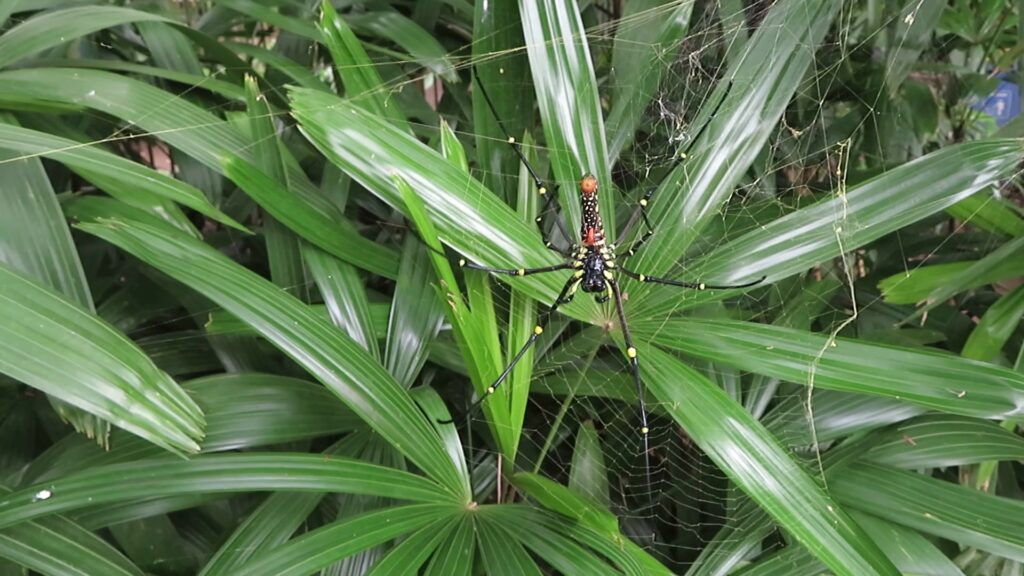
Nephilidae is a family of spiders within the order Araneae, commonly associated with large orb-weaving spiders known for their impressive webs, substantial body size, and pronounced differences between males and females. These spiders are particularly notable in tropical and subtropical regions, where they inhabit forests, gardens, woodland edges, and other environments with suitable vegetation for web construction. Their classification has changed over time, and some taxonomic systems have placed these spiders within the family Araneidae, so the exact family-level treatment depends on the classification being followed.
Members of Nephilidae are best known for constructing large, circular orb webs that can span considerable distances between branches, tree trunks, and other supports. The webs are built from silk produced by specialized abdominal glands and serve as traps for flying insects. In some species, the silk has a golden or yellowish appearance in sunlight, giving rise to the common name golden orb-weavers. The web’s structure allows it to intercept prey while remaining flexible enough to absorb impacts without immediately breaking.
Nephilid spiders generally have elongated bodies and long, slender legs adapted for gripping vegetation and manipulating silk. Females are often much larger and more robust than males, making sexual size dimorphism one of the group’s most recognizable features. In some species, females can construct webs several metres across, while the much smaller males may live on the edge of a female’s web or nearby vegetation. This striking difference in size is an important aspect of their biology and reproductive behavior.
The family is found mainly in tropical and subtropical regions of Africa, Asia, Australia, and the Americas. Different genera occupy distinct geographic ranges and habitats. Some species are common in tropical forests, while others thrive in gardens, plantations, woodland edges, and areas near human settlements. Their distribution is influenced by climate, vegetation, the availability of suitable web supports, and the abundance of flying insects.
Nephilid spiders are predators that feed primarily on insects caught in their webs, including flies, moths, beetles, bees, and other flying arthropods. When prey becomes entangled in the silk, the spider detects the vibrations and moves toward it to capture and immobilize it. The large webs of some species allow them to intercept relatively large prey and exploit open spaces between trees and shrubs. By consuming insects, these spiders contribute to the regulation of arthropod populations within their habitats.
Reproduction in Nephilidae is characterized by pronounced differences between males and females in many species. Females are usually substantially larger, while males are smaller and may live near the edge of a female’s web. Males approach females to mate, sometimes facing the risk of being attacked or eaten. After mating, females produce egg sacs containing numerous eggs and attach them to sheltered surfaces or vegetation. The young hatch as spiderlings and eventually disperse to establish their own webs.
The family includes several distinctive genera, such as Nephila, Trichonephila, Herennia, Nephilengys, Nephilingis, Clitaetra, and Indoetra. Species of Nephila and Trichonephila are particularly well known for their large golden orb webs, while Herennia includes coin spiders that commonly construct webs closely associated with tree trunks. These genera differ in web architecture, body form, reproductive behavior, and geographic distribution.
Nephilid spiders are generally not considered dangerous to humans. Although they may bite if handled or threatened, they are not regarded as medically significant in ordinary encounters. Their large size and conspicuous webs may appear intimidating, but they usually remain focused on capturing prey and maintaining their webs. Avoiding unnecessary handling allows these spiders to continue their ecological role without disturbance.
The family-level classification of Nephilidae has changed over time. Some taxonomic systems recognize Nephilidae as a separate family, while others place these spiders in the subfamily Nephilinae within Araneidae, the family of typical orb-weaver spiders. This difference reflects ongoing discussion about how spider evolutionary relationships should be represented in classification. The genera traditionally associated with nephilids nevertheless form a recognizable group of large orb-weaving spiders with distinctive biological characteristics.
Overall, Nephilidae represents a distinctive group of orb-weaving spiders known for their large webs, strong silk, pronounced sexual size differences, and important role as insect predators. Their varied web-building strategies allow them to occupy a wide range of tropical and subtropical habitats. As conspicuous members of many forest and garden ecosystems, these spiders contribute to biodiversity and help maintain the ecological balance of insect communities.