

Indo-Chinese Rat Snake (Ptyas korros)
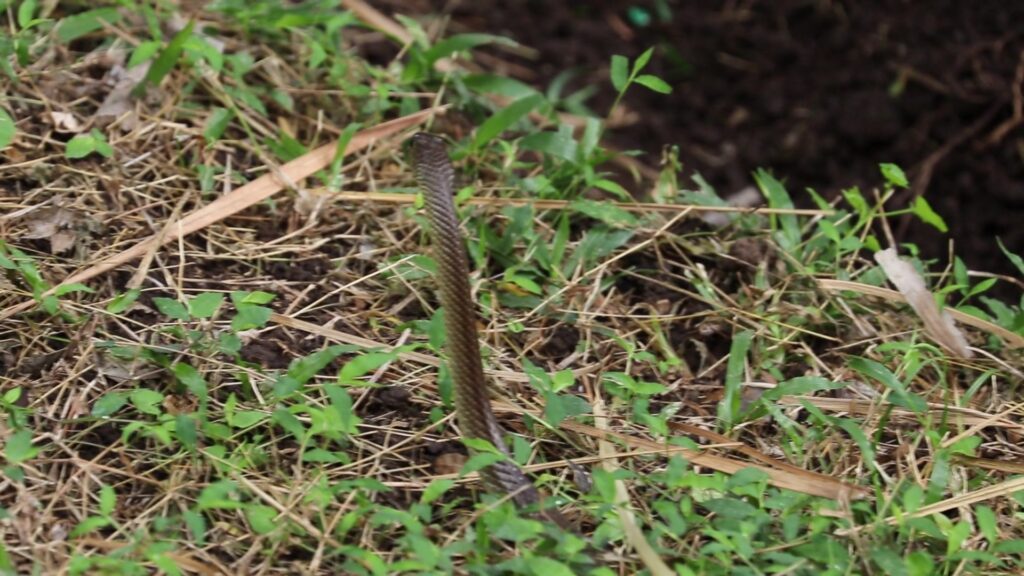
Ptyas korros, commonly known as the Indochinese rat snake or Indo-Chinese rat snake, is a nonvenomous species of snake in the family Colubridae. It belongs to the genus Ptyas, a group of fast-moving snakes widely distributed across South, Southeast, and East Asia. This species is known for its slender body, alert behavior, and adaptability to a variety of natural and human-modified habitats. Although it can appear intimidating when encountered, it is not venomous and generally attempts to escape when disturbed. Its diet includes rodents and other small animals, making it a useful predator in agricultural landscapes and rural environments.
The Indochinese rat snake has a long, slender body, a relatively narrow head, and a tapering tail. Adults are commonly brown, olive-brown, grayish, or yellowish-brown, with coloration varying according to age and geographical population. The scales may have darker edges or subtle patterns that give the body a somewhat mottled appearance. The underside is generally paler, often yellowish or cream-colored. Juveniles may show more conspicuous markings than adults, and coloration can become more uniform as the snake matures. Its large eyes and elongated body are consistent with an active, visually oriented predator capable of moving rapidly across the ground and through vegetation.
Ptyas korros occurs across parts of mainland Southeast Asia and neighboring regions of South and East Asia. Its distribution includes countries such as Myanmar, Thailand, Laos, Cambodia, Vietnam, and parts of southern China, with records extending into the Malay Peninsula and surrounding areas. Its precise range may vary among taxonomic treatments and regional records. The species inhabits a broad range of environments, including tropical and subtropical forests, forest margins, grasslands, scrub, plantations, agricultural fields, and areas near human settlements. It is frequently associated with landscapes where small vertebrates are abundant and where vegetation, soil cavities, or other structures provide suitable shelter.
This species is predominantly terrestrial but can climb shrubs and trees when searching for prey or avoiding danger. It is generally active during the day, although activity may vary with local temperatures, rainfall, and habitat conditions. During periods of intense heat, it may remain concealed beneath vegetation, fallen timber, stones, or within burrows and other sheltered spaces. Its slender body and muscular build allow it to move quickly through grass, leaf litter, and open ground. When disturbed, it often relies on speed and nearby cover to escape rather than remaining in the open.
The Indochinese rat snake is a carnivorous predator with a varied diet. Its prey may include rats, mice, frogs, lizards, small birds, and other appropriately sized vertebrates. The importance of each prey type depends on the snake’s age, body size, habitat, and local prey availability. Young snakes generally consume smaller animals, while larger individuals can capture larger prey. The species relies on rapid movement, accurate strikes, and strong jaws to seize and restrain its food. By consuming rodents, it can contribute to the natural regulation of animals that sometimes damage crops or stored food.
Although Ptyas korros is nonvenomous, it can behave defensively when cornered or handled. A threatened individual may flee rapidly, raise the front portion of its body, flatten its neck slightly, hiss, or strike repeatedly. Its bite can be painful and may cause bleeding because of its numerous small teeth. Such behavior is primarily defensive and does not mean that the snake actively seeks out people. Like other wild snakes, it is best observed from a safe distance and left undisturbed.
Reproduction is oviparous, meaning that females lay eggs. Breeding activity is influenced by seasonal temperatures, rainfall, and local environmental conditions. After mating, a female deposits a clutch in a sheltered location, potentially among decaying vegetation, within a soil cavity, beneath logs, or in another protected site that provides suitable conditions for egg development. The eggs incubate outside the mother’s body, and the hatchlings emerge as independent snakes. The young must find their own food and shelter from an early age. Detailed reproductive timing and clutch characteristics can vary across the species’ geographical range.
Ecologically, Ptyas korros occupies an important position as a predator of small vertebrates. Its consumption of rodents may benefit agricultural systems, while its predation on frogs and lizards contributes to the broader regulation of prey populations. In turn, the snake can serve as food for larger snakes, birds of prey, and other carnivores. Its ability to persist in some disturbed habitats allows it to remain part of the food web in agricultural and semi-urban environments, although this adaptability does not eliminate the effects of habitat degradation.
The species faces threats from habitat conversion, road traffic, accidental killing, and deliberate persecution caused by fear or confusion with venomous snakes. Agricultural chemicals may also affect it indirectly by reducing prey populations or contaminating the food web. In some areas, snakes are killed when encountered around houses, farms, or roads, even when they pose little danger to people. Maintaining natural vegetation, reducing unnecessary killing, and improving public knowledge of snake identification can help support local populations.
Ptyas korros is a characteristic Southeast Asian rat snake distinguished by its slender build, rapid movements, broad diet, and ability to occupy diverse habitats. As a nonvenomous predator, it contributes to ecosystem function and can help control rodent populations in agricultural landscapes. Although its defensive displays may be alarming, it generally benefits from being left undisturbed rather than captured or killed. Understanding its natural history provides a clearer appreciation of its ecological value and the role that nonvenomous snakes play in maintaining biodiversity.