

Spotted Dove (Spilopelia chinensis)
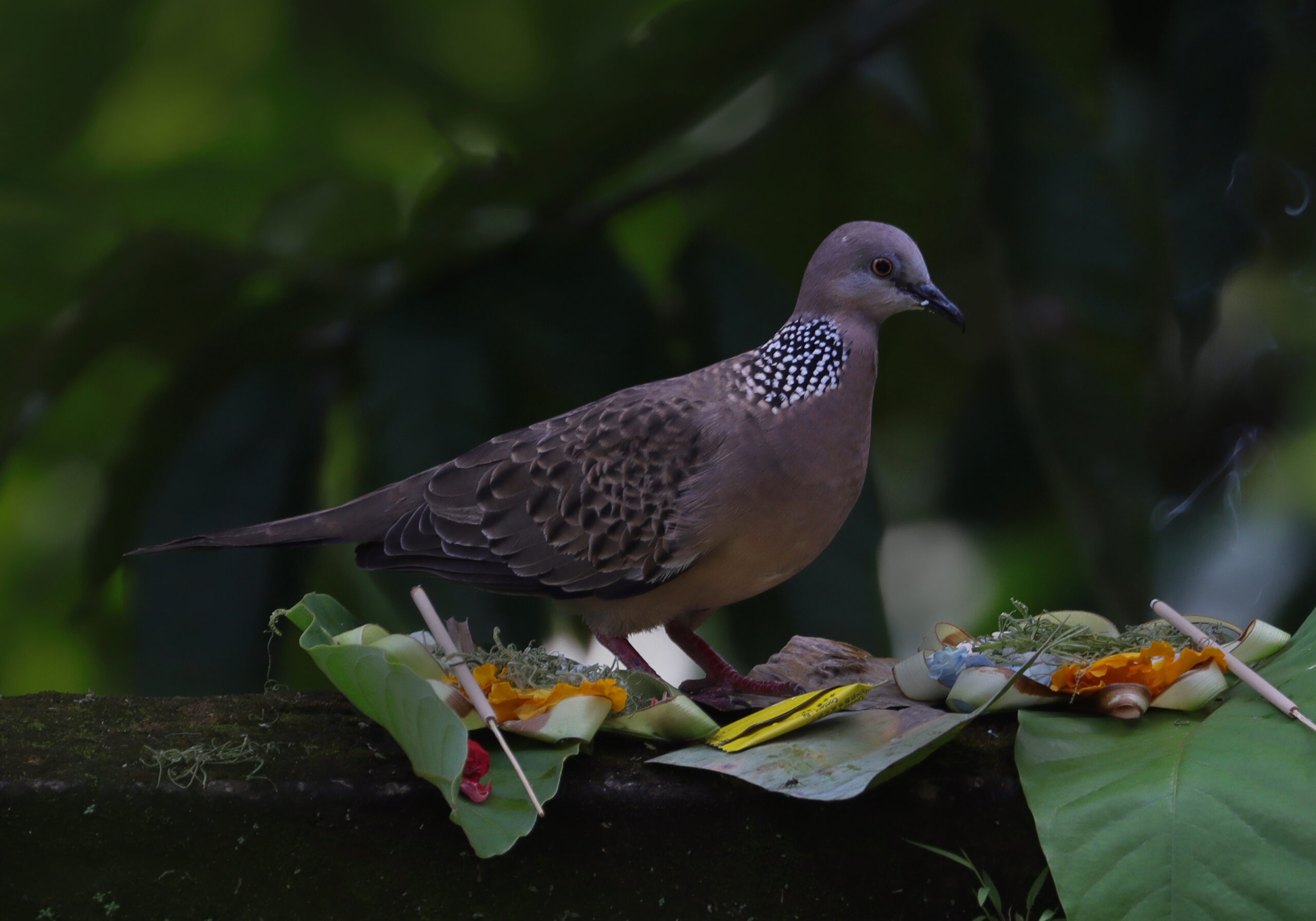
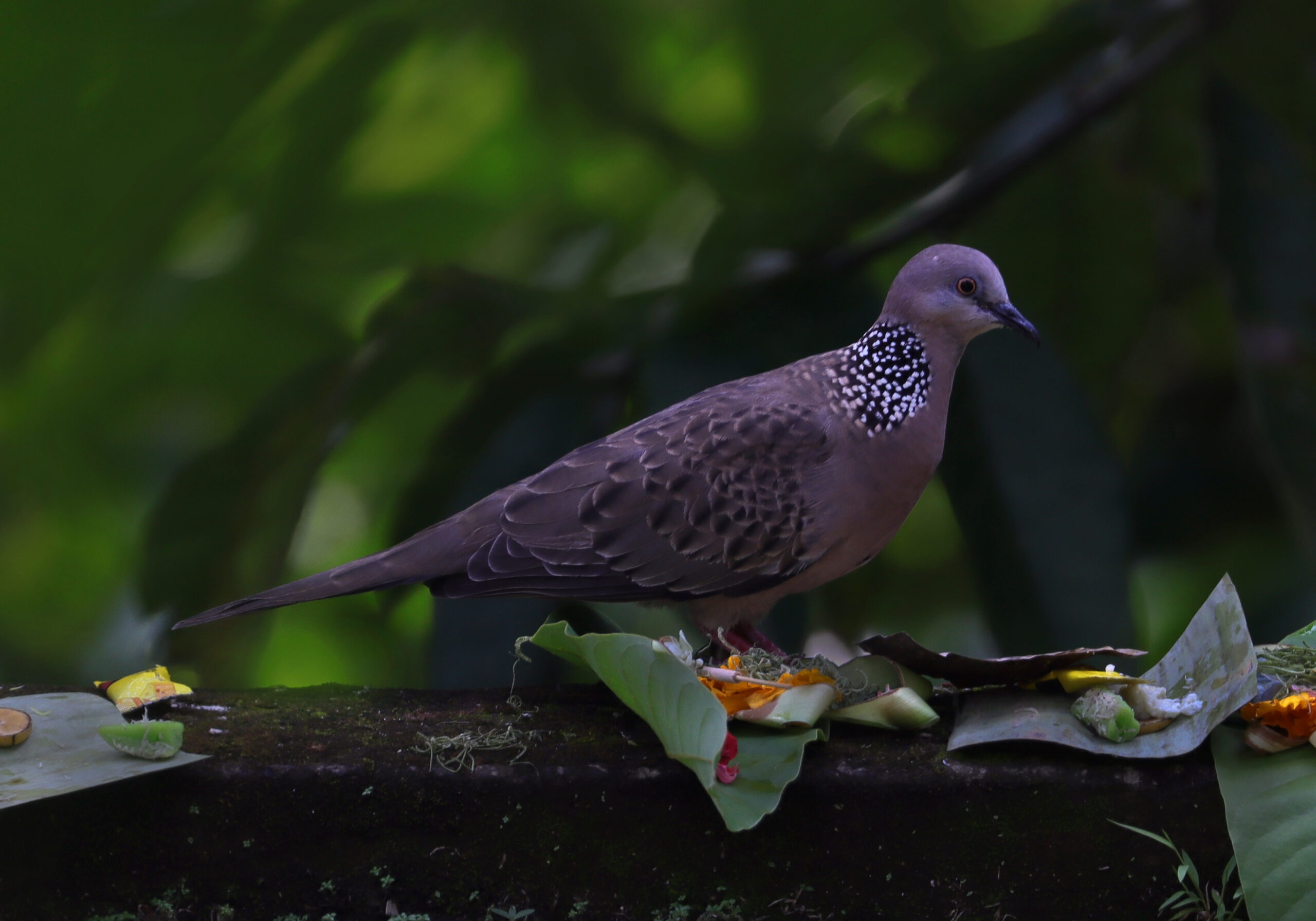
Spilopelia chinensis is a species of dove belonging to the genus Spilopelia (Family Columbidae, Order Columbiformes). Commonly known as the Spotted Dove, it is widely distributed across South Asia, Southeast Asia, East Asia, and parts of the Indo-Pacific. The species has also been introduced to several regions outside its native range, including Australia, Hawaii, and other Pacific islands. It inhabits woodlands, forest edges, scrublands, agricultural fields, plantations, villages, parks, gardens, and urban environments, where it readily adapts to human-modified landscapes.
Spilopelia chinensis is a medium-sized dove measuring approximately 28–32 cm in length, with a wingspan of 45–55 cm. It has a slender body, a relatively small rounded head, a long graduated tail, and pointed wings adapted for swift, direct flight. The plumage is predominantly pinkish-brown to grayish-brown, with finely scaled black and buff markings on the wings and back. Its most distinctive feature is the black patch on the sides and back of the neck, densely covered with small white spots, giving the species its common name. The underparts are pale pinkish-gray, the eyes are reddish-brown, the bill is dark gray to black, and the legs are pink to reddish.
Adults are diurnal and are usually observed singly, in pairs, or in small flocks. They spend much of the day foraging on the ground with a characteristic bobbing walk, taking flight rapidly when disturbed with strong, direct wingbeats. Their vocalization is a soft, repetitive series of melodious coos that is commonly heard during the breeding season and serves for mate attraction and territorial communication. Courtship involves bowing displays, tail spreading, and short display flights.
The Spotted Dove is primarily granivorous, feeding mainly on grass seeds, cereal grains, rice, millet, weed seeds, and fallen fruits. It occasionally consumes small insects, snails, and other invertebrates, particularly during the breeding season when additional protein is beneficial. Foraging typically occurs in open areas, beneath shrubs, or along roadsides and cultivated fields.
The life cycle includes egg, nestling, fledgling, juvenile, and adult stages. Breeding pairs construct a simple platform nest of twigs and grasses in trees, shrubs, hedges, or occasionally on buildings. Females usually lay two smooth white eggs, and both parents share incubation duties for about 13–15 days. Newly hatched chicks are initially fed crop milk, followed by softened seeds. The young generally fledge within 12–16 days, although they remain dependent on their parents for a short period afterward.
Spilopelia chinensis is one of the most widespread and familiar doves throughout its range. Its adaptability allows it to thrive in both natural habitats and urban environments, where it often coexists closely with humans.
Ecologically, the Spotted Dove plays an important role in seed dispersal and the regulation of weed populations through its feeding habits. It also serves as prey for raptors, snakes, and terrestrial mammals, contributing to local food webs. Because of its broad distribution, ecological adaptability, and sensitivity to severe habitat degradation, Spilopelia chinensis is considered a useful indicator of habitat quality, landscape change, and regional biodiversity.