

Diadems & Eggflies (Genus Hypolimnas)
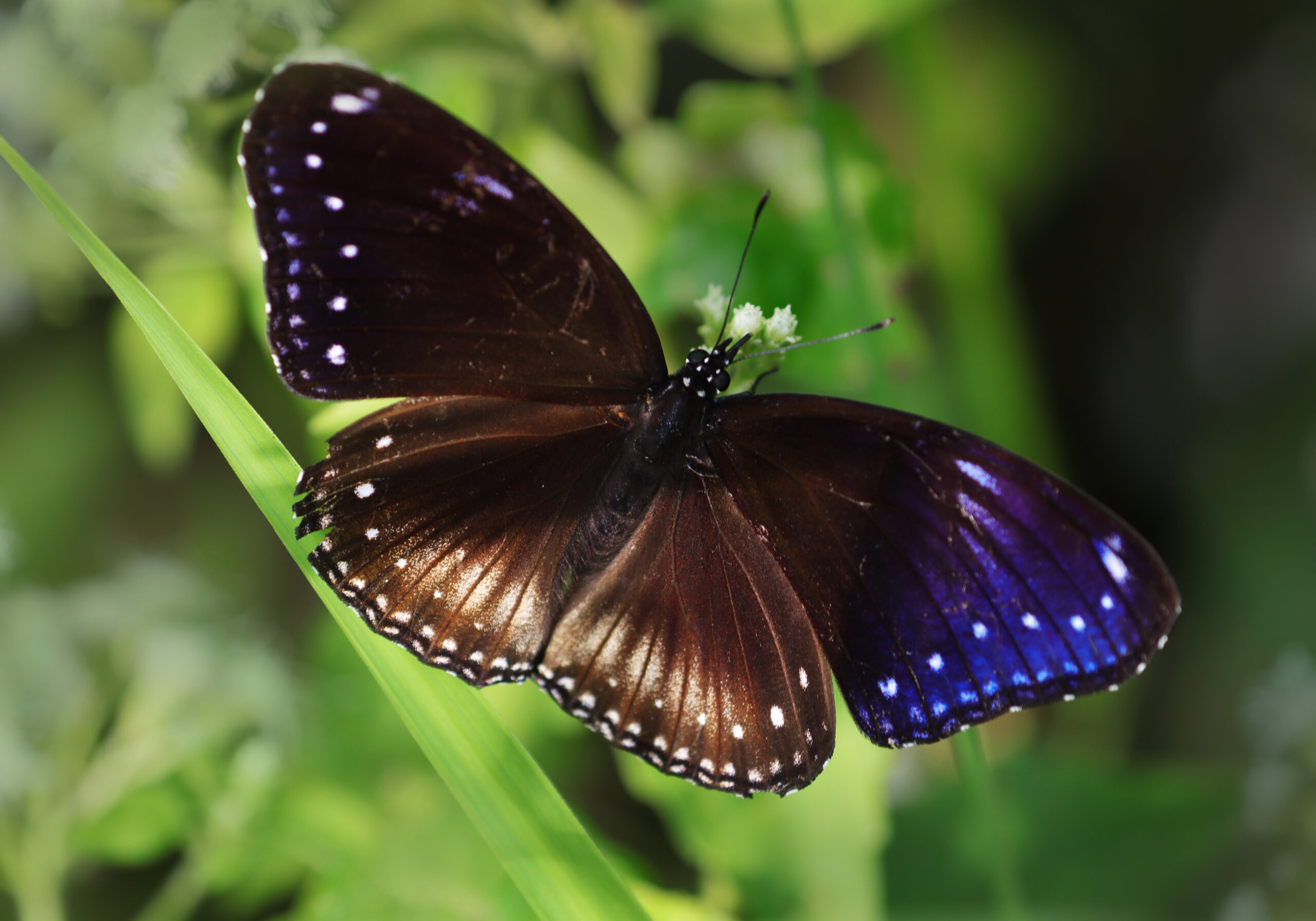
Hypolimnas is a genus of brush-footed butterflies within the tribe Junoniini (Subfamily Nymphalinae, Family Nymphalidae, Superfamily Papilionoidea, Order Lepidoptera). Commonly known as the eggflies, the genus comprises approximately 25–30 described species distributed throughout tropical and subtropical regions of Africa, Asia, Australia, and the Indo-Pacific, with a few species extending into southern Europe and Pacific islands. Members inhabit tropical rainforests, secondary forests, woodland edges, mangroves, grasslands, agricultural fields, parks, gardens, and urban green spaces.
Butterflies of the genus Hypolimnas are generally medium to large in size, with a wingspan ranging from 60–90 mm. They possess a robust body and broad, rounded wings that often display bold patterns and striking sexual dimorphism. Males are typically dark brown or black with iridescent blue, violet, or white patches, while females are often more variable in coloration and pattern. In several species, females exhibit remarkable Batesian mimicry, closely resembling distasteful butterflies such as members of the genus Danaus, thereby reducing the risk of predation.
Adults are diurnal and are strong, agile fliers that frequently bask with their wings spread in sunny locations. They feed primarily on nectar from a wide variety of flowering plants using their long, coiled proboscis. They also obtain nutrients from fermenting fruits, tree sap, animal dung, carrion, and mineral-rich mud. Males commonly engage in mud-puddling, gathering on damp soil or stream banks to absorb sodium and other minerals important for reproduction. Many species are territorial, with males actively defending sunlit perches or open clearings.
The life cycle involves complete metamorphosis, consisting of egg, larva (caterpillar), pupa (chrysalis), and adult stages. Females lay eggs singly on the leaves of host plants. Caterpillars are cylindrical and bear numerous branched spines that provide protection against predators. They feed mainly on plants belonging to the families Acanthaceae, Malvaceae, Portulacaceae, Amaranthaceae, and several others, depending on the species. Pupation occurs on leaves, stems, or nearby vegetation, where the angular chrysalis hangs suspended by its cremaster.
The genus includes several well-known species, such as Hypolimnas bolina (Great Eggfly), Hypolimnas misippus (Danaid Eggfly), Hypolimnas anomala, Hypolimnas alimena, and Hypolimnas dexithea. Many species are common in disturbed habitats and gardens, where their conspicuous appearance and territorial behavior make them easily observed.
Ecologically, Hypolimnas butterflies are important pollinators of flowering plants and contribute to plant reproduction across a variety of ecosystems. Their caterpillars participate in plant–herbivore interactions, while both larvae and adults provide food for birds, reptiles, spiders, predatory insects, and parasitoids. Their wide distribution, ecological adaptability, and sensitivity to habitat disturbance make Hypolimnas species valuable indicators of ecosystem health, habitat quality, and biodiversity.