

Crow Butterflies (Genus Euploea)
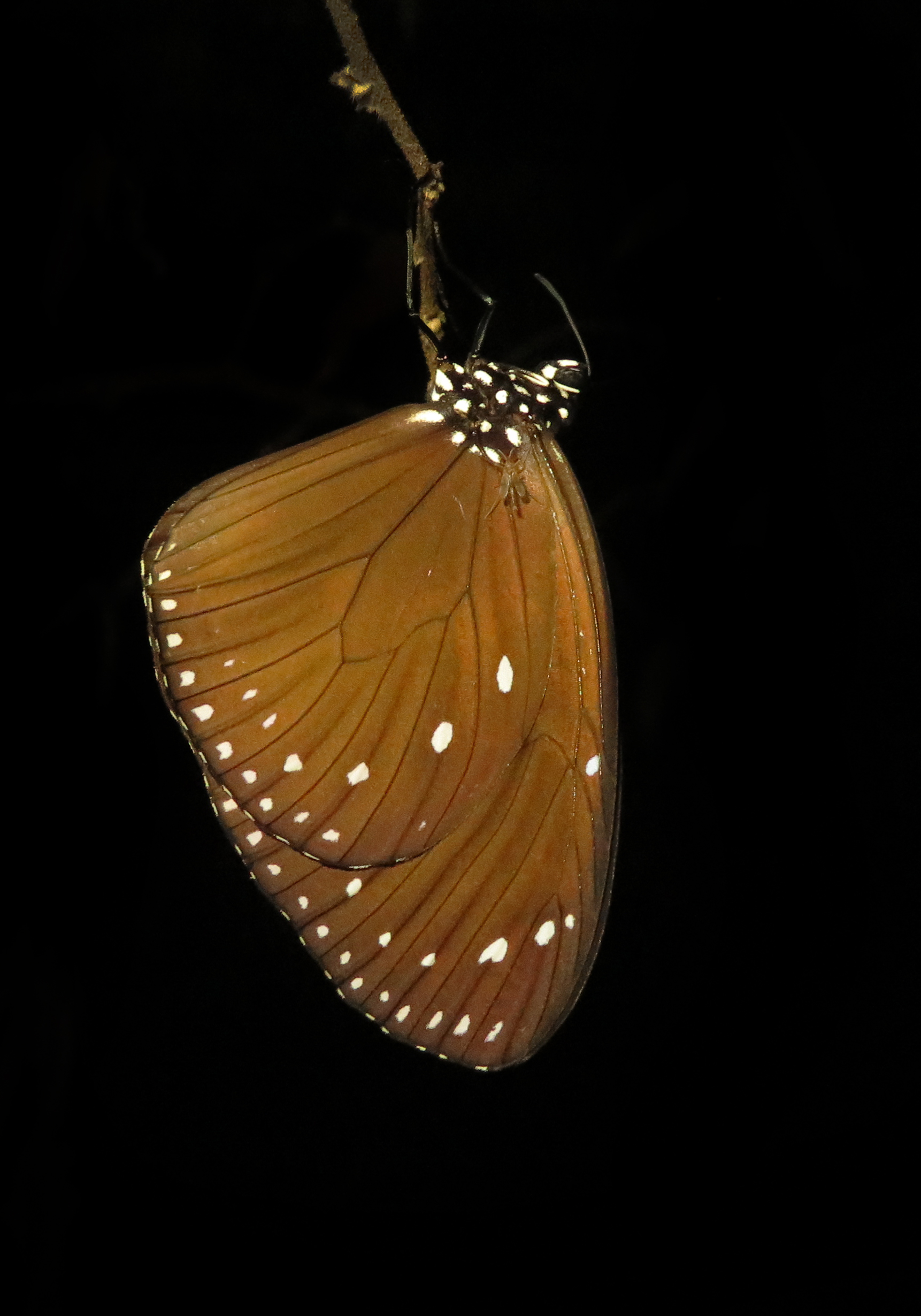
Euploea is a genus of brush-footed butterflies within the subtribe Euploeina (Tribe Danaini, Subfamily Danainae, Family Nymphalidae, Superfamily Papilionoidea, Order Lepidoptera). Commonly known as the crows, the genus comprises more than 50 described species distributed throughout South Asia, Southeast Asia, East Asia, Australia, New Guinea, and the islands of the Indo-Pacific. Members inhabit tropical rainforests, secondary forests, mangroves, woodland edges, coastal forests, plantations, parks, and gardens, where they are among the most familiar forest butterflies.
Butterflies of the genus Euploea are generally medium to large-sized, with a wingspan of approximately 60–110 mm. They possess a robust body and broad, rounded wings. Like all members of the family Nymphalidae, their forelegs are reduced and brush-like, making them functionally four-legged. Wing coloration is predominantly dark brown, black, bluish-black, or chocolate-brown, often decorated with rows of white, bluish-white, or pale blue spots along the wing margins and across the wings. Males of many species possess distinctive androconial scent patches or brands on the hindwings, which release pheromones during courtship. Their subdued but elegant coloration serves as aposematic (warning) coloration, signaling the presence of toxic compounds accumulated from larval host plants.
Adults are diurnal and are characterized by a slow, graceful, and gliding flight. They commonly visit flowering plants to feed on nectar using their long, coiled proboscis, while also feeding on tree sap, fermenting fruits, and mineral-rich moisture. Males frequently seek out plants containing pyrrolizidine alkaloids, which are used to produce courtship pheromones and reinforce their chemical defenses. Several species undertake seasonal or local migrations, forming conspicuous aggregations during movement.
The life cycle involves complete metamorphosis, consisting of egg, larva (caterpillar), pupa (chrysalis), and adult stages. Females lay eggs singly on the leaves of host plants. Caterpillars are smooth-bodied and bear several pairs of long, fleshy filaments on the thoracic and abdominal segments. They feed primarily on plants in the family Apocynaceae, especially milkweeds and related vines. By consuming these plants, the larvae sequester toxic cardiac glycosides and other defensive chemicals that remain in the adult butterfly, making it distasteful to many predators. Pupation occurs on vegetation, where the chrysalis hangs suspended by its cremaster and often displays metallic gold or silver spots.
The genus includes numerous well-known species, such as Euploea core (Common Crow), Euploea mulciber (Striped Blue Crow), Euploea midamus (Blue-spotted Crow), Euploea radamanthus (Magpie Crow), and Euploea sylvester (Double-branded Crow). Many of these species participate in Müllerian mimicry, while unrelated butterflies imitate their appearance through Batesian mimicry.
Ecologically, Euploea butterflies are important pollinators that contribute to the reproduction of many flowering plants. Their caterpillars influence host-plant populations through herbivory, while both larvae and adults provide food for specialized predators and parasitoids capable of tolerating their chemical defenses. Because they are closely associated with native forest vegetation and specific host plants, Euploea butterflies are valuable indicators of forest health, habitat quality, and regional biodiversity.