

Giant Wood Spiders (Genus Nephila)
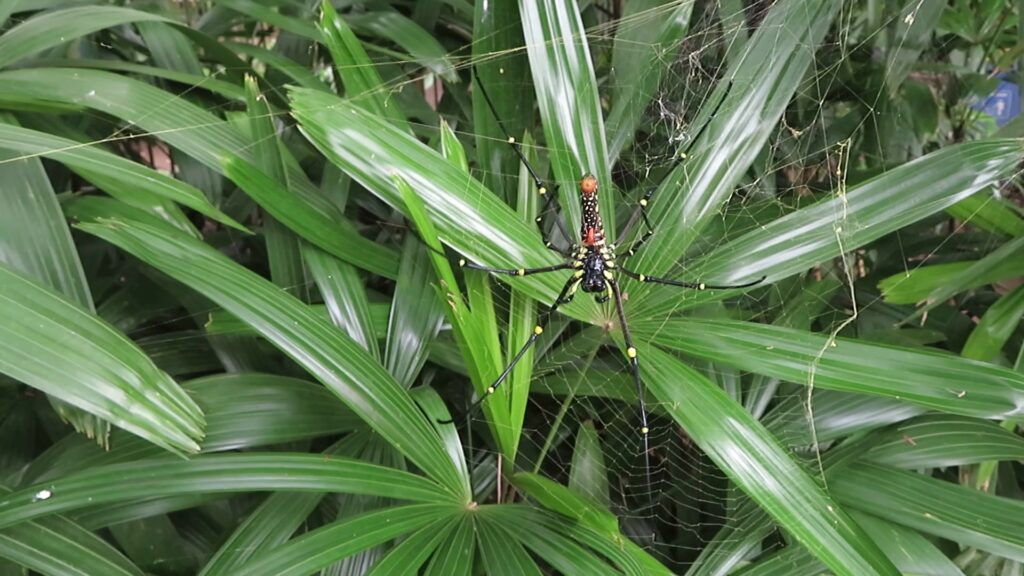
Nephila is a genus of large orb-weaving spiders belonging to the family Nephilidae in classifications that recognize this family separately, or to the family Araneidae in classifications that place these spiders among the typical orb-weavers. Members of this group are commonly known as golden orb-weavers because of the golden-yellow silk produced by many species. They are notable for their large body size, long legs, intricate webs, and pronounced differences in size between males and females. These spiders are primarily associated with tropical and subtropical environments, where they capture flying insects using expansive silk webs.
Spiders of the genus Nephila generally have elongated bodies, long slender legs, and distinctive coloration. Females are usually much larger than males, with robust abdomens and conspicuous patterns of yellow, brown, black, or silvery markings. Their legs often display contrasting bands or tufts of hair. Males are considerably smaller and more delicate, with less conspicuous coloration. This pronounced sexual size dimorphism is one of the most recognizable characteristics of these spiders and influences their behavior and reproductive ecology.
One of the defining features of Nephila is the construction of large orb-shaped webs supported by strong anchor lines attached to branches, shrubs, tree trunks, or other structures. The silk often appears golden when illuminated by sunlight, although its visibility varies with lighting conditions and the surrounding vegetation. The webs consist of radial threads connected by a spiral capture zone that intercepts flying insects. Their size and placement allow the spiders to exploit open spaces in forests, woodland edges, gardens, and other habitats where airborne prey is abundant.
The genus has traditionally been associated with tropical and subtropical regions of Asia, Africa, and Australasia. Species occupy a variety of habitats, including tropical rainforests, secondary forests, plantations, mangrove margins, gardens, and woodland clearings. Their distribution depends on local climate, suitable web-building supports, and the availability of insects. Some species are frequently encountered near human settlements, particularly where vegetation provides suitable locations for large webs.
Nephila spiders are predators that feed mainly on insects caught in their webs. Their prey may include flies, moths, beetles, bees, wasps, and other flying arthropods. When an insect becomes trapped, the spider detects the vibrations transmitted through the silk and approaches to immobilize it. The strong web can retain relatively large prey, although the spider’s ability to subdue an animal depends on its size and the circumstances of capture. By consuming insects, these spiders contribute to the regulation of arthropod populations in their habitats.
The reproductive behavior of Nephila is strongly influenced by the substantial size difference between the sexes. Small males typically approach females on or near their webs and use cautious movements to reduce the risk of being mistaken for prey. After mating, females produce egg sacs containing numerous eggs and place them in protected locations among vegetation. The spiderlings hatch as small, independent spiders and eventually disperse to establish their own webs. The timing of reproduction and the number of eggs vary among species and environmental conditions.
The taxonomy of Nephila has undergone substantial revision. Several species historically assigned to this genus have been transferred to the genus Trichonephila, which is now recognized separately in many modern classifications. Consequently, older literature may use Nephila for species that are currently placed elsewhere. This distinction is important when comparing species records, scientific descriptions, and geographic distributions.
Golden orb-weavers are generally not considered medically dangerous to humans. They may bite if handled or threatened, but they are typically nonaggressive and prefer to remain on their webs. Their large size and prominent webs can appear intimidating, yet they play a beneficial ecological role as predators of insects. Avoiding unnecessary disturbance helps protect both the spiders and the intricate webs they construct.
Overall, Nephila represents a historically important genus of large orb-weaving spiders known for golden silk, expansive webs, long legs, and pronounced sexual size dimorphism. Its members are adapted to warm environments where flying insects and suitable web supports are abundant. Although the genus’s taxonomic boundaries have changed, these spiders remain notable examples of the diversity, behavioral complexity, and ecological importance of orb-weaving arachnids.