

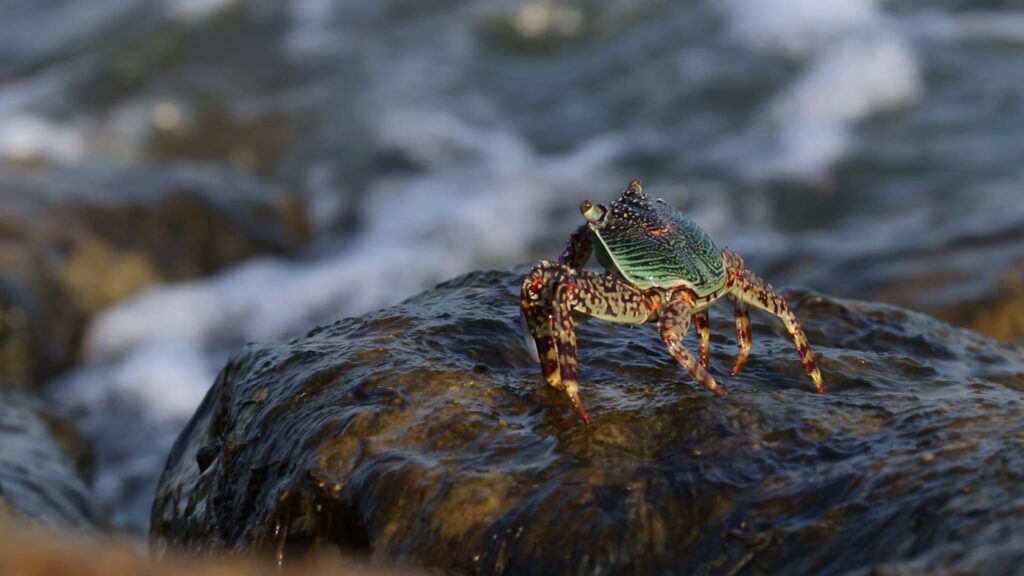
Mottled Lightfoot Crab (Grapsus albolineatus)
-
Animals(Kingdom Animalia)
- Arthropods(Phylum Arthropoda)
Grapsus albolineatus, commonly known as the white-striped rock crab or mottled lightfoot crab, is a species of marine crab belonging to the family Grapsidae, superfamily Grapsoidea, and order Decapoda. It is widely distributed throughout the tropical Indo-Pacific region, occurring along rocky coastlines, coral reef margins, oceanic islands, and wave-exposed intertidal habitats. The species has a flattened, roughly quadrangular carapace, long walking legs, and strong claws adapted for gripping surfaces and handling food. Its coloration is typically mottled with shades of green, brown, gray, and pale markings, which provide camouflage against algae-covered rocks and uneven coastal substrates. Grapsus albolineatus is highly agile and can move rapidly across wet rocks, often retreating into crevices when threatened by predators or disturbed by waves. It is commonly observed in the intertidal zone, where it tolerates periodic exposure to air, fluctuating temperatures, and strong wave action. Its diet consists mainly of algae and other organic material scraped from rocky surfaces, supplemented by detritus and small marine organisms when available. Through grazing and scavenging, the species contributes to the regulation of algal growth and the recycling of organic matter in rocky shore ecosystems. Reproduction involves females carrying fertilized eggs beneath the abdomen before releasing larvae into coastal waters, where they undergo planktonic development before settling into suitable habitats. The crab also forms part of the coastal food web, serving as prey for fish, seabirds, and other marine predators. Although it is adapted to dynamic shoreline conditions, local populations may be affected by coastal pollution, habitat disturbance, and degradation of rocky intertidal environments. Through its specialized adaptations for life on exposed shores and its role in coastal food webs, Grapsus albolineatus is a characteristic crab of tropical Indo-Pacific rocky coastlines.