

Genus Erionota
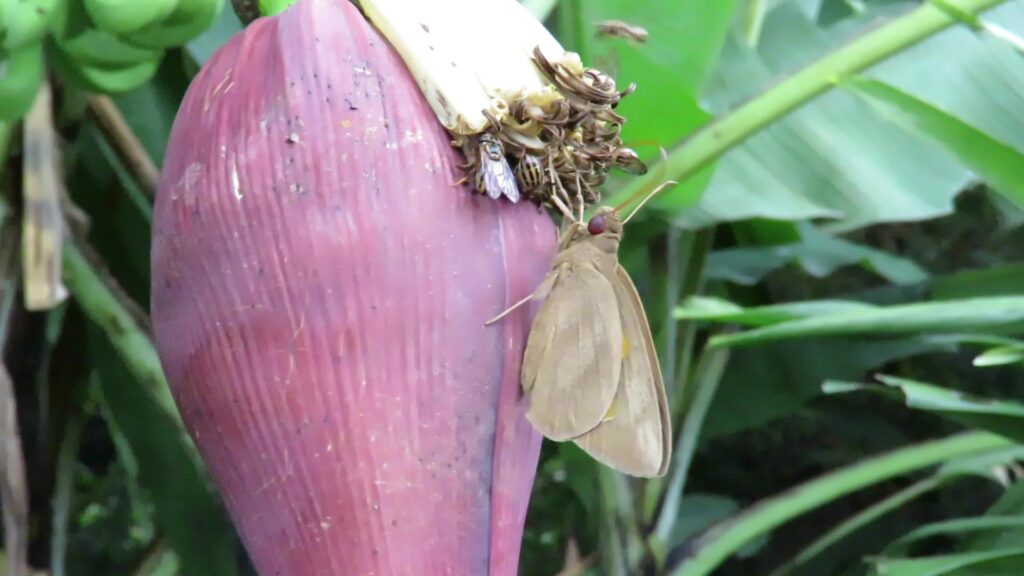
The genus Erionota comprises a group of large skipper butterflies belonging to the family Hesperiidae and subfamily Hesperiinae. These butterflies are native primarily to South and Southeast Asia, where they inhabit tropical and subtropical forests, plantations, gardens, and other landscapes with suitable larval host plants. Members of the genus are recognized by their robust bodies, relatively broad wings, rapid flight, and characteristic resting posture. Several species are associated with palms and banana plants, and some have become important agricultural pests because their caterpillars feed on the leaves of cultivated plants. Their life cycles and feeding habits make them significant components of tropical insect communities.
Adult Erionota butterflies generally have stout bodies, broad heads, and relatively short, strong antennae that terminate in hooked or curved clubs, a characteristic feature of skipper butterflies. Their wings are commonly brown or dark brown, often with pale, translucent patches on the forewings. The wings may have darker margins and subtle variations in colour or pattern that help distinguish species. Compared with many other butterflies, members of Erionota tend to have a sturdy appearance and powerful flight muscles. Their wings are adapted for rapid, direct movement, allowing them to travel efficiently between feeding sites, host plants, and sheltered resting locations.
The forewings of Erionota are usually elongated and triangular, while the hindwings are broader and may have rounded or slightly angular margins. Wing markings are generally less elaborate than those of many brightly coloured butterfly groups, with brown backgrounds and lighter translucent spots providing the principal identifying features. The undersides of the wings are often similar in colour to the upper surfaces but may appear paler or more subdued. The body is typically covered with fine scales and hairs, which provide insulation and sensory protection. As in other skipper butterflies, the antennae and compound eyes are important for detecting environmental cues during flight, feeding, and reproduction.
The distribution of Erionota extends across tropical and subtropical parts of Asia, including regions of the Indian subcontinent, mainland Southeast Asia, and the Malay Archipelago. Different species occupy distinct geographic ranges, with some occurring on islands and others distributed across larger continental areas. Their habitats include lowland forests, forest edges, plantations, village gardens, and cultivated landscapes where host plants are abundant. Some species tolerate disturbed environments particularly well because their caterpillars can use cultivated palms or banana plants. Their occurrence is influenced by temperature, rainfall, vegetation, and the availability of suitable plants for egg laying and larval development.
Adult Erionota feed primarily on liquid nutrients such as flower nectar, although some may also obtain minerals and other substances from damp soil, decaying organic matter, or animal waste. Their long, coiled proboscis allows them to reach nectar within flowers. Adults often visit flowering vegetation along forest margins, paths, gardens, and plantations, where they can obtain energy for flight, survival, and reproduction. Their feeding behaviour may contribute to pollination when pollen is transferred between flowers, although their ecological importance as pollinators varies with species and plant associations.
The caterpillars of Erionota are generally more conspicuous in their feeding behaviour than the adults. Many species use plants in the palm family (Arecaceae), while some are associated with bananas and related plants in the order Zingiberales. The larvae feed on leaves and may fold, roll, or tie sections of foliage together with silk to form protective shelters. These shelters provide concealment from predators, reduce exposure to harsh environmental conditions, and offer a protected place for resting between feeding periods. As the caterpillar grows, it moults through successive larval stages and may construct or enlarge its shelter to accommodate its increasing body size.
The larval stage is particularly important in the agricultural ecology of certain Erionota species. For example, the palm-restricted Erionota thrax, commonly known as the banana skipper, is well known for feeding on banana leaves and can cause substantial defoliation when populations are high. Caterpillars cut or fold sections of the leaf and consume the foliage from within their shelters. Heavy infestations can reduce the photosynthetic area of plants and affect the appearance and productivity of banana crops. However, the severity of damage depends on the species, larval density, plant condition, and environmental circumstances. Not every species in the genus is an agricultural pest.
Reproduction in Erionota follows the typical pattern of butterflies, involving eggs, caterpillars, pupae, and adults. Females generally lay their eggs on or near suitable host plants, allowing the newly hatched larvae to begin feeding soon after emergence. The caterpillars pass through several growth stages before entering the pupal stage. Pupation often takes place within a shelter constructed from plant material and silk, which offers protection during metamorphosis. The adult butterfly eventually emerges, expands and dries its wings, and begins feeding and seeking mates. The duration of development varies with species, temperature, rainfall, and the nutritional quality of the host plant.
Like other butterflies, Erionota undergoes complete metamorphosis, with each life stage occupying a distinct ecological role. Eggs are relatively immobile and depend on suitable placement for successful development. Caterpillars specialize in feeding and growth, while pupae undergo the transformation into adults. Adult butterflies focus on dispersal, feeding, mating, and reproduction. The ability to use cultivated plants has enabled some species to thrive in human-modified environments, while other members remain associated more closely with natural vegetation. Seasonal changes in rainfall and plant growth can influence the timing and abundance of each life stage.
Members of Erionota form part of tropical food webs and interact with a range of predators and parasitoids. Eggs and caterpillars may be attacked by parasitoid wasps, flies, ants, spiders, and predatory insects, while adult butterflies can be preyed upon by birds, lizards, and other insectivores. Leaf shelters provide some protection to the larvae, but they do not eliminate the risk of predation or parasitism. These natural enemies can influence population sizes and may help limit outbreaks in agricultural landscapes. The genus also contributes to insect diversity in forests and plantations, where its members interact with host plants and flowering vegetation.
The taxonomy of Erionota is based on adult wing patterns, wing venation, antennal structure, body morphology, and characteristics of the male and female reproductive organs. Larval morphology, host-plant associations, geographic distribution, and molecular evidence can provide additional information for distinguishing species. Because skipper butterflies contain many closely related species with similar external appearances, reliable identification may require detailed examination rather than colour pattern alone. Taxonomic studies continue to refine understanding of relationships within Hesperiidae and the placement of individual Erionota species.
Overall, Erionota is a distinctive genus of Asian skipper butterflies characterized by robust bodies, rapid flight, brown wings with pale markings, and caterpillars adapted to feeding on particular groups of plants. Its members occupy a variety of tropical habitats, including forests, gardens, and plantations. While adult butterflies participate in nectar feeding and broader insect–plant interactions, the caterpillars of certain species can have considerable agricultural significance, especially on bananas and palms. Understanding their life cycles, host-plant preferences, and natural enemies is important for appreciating their ecological roles and managing species that become crop pests.