

White-breasted Waterhen (Amaurornis phoenicurus)
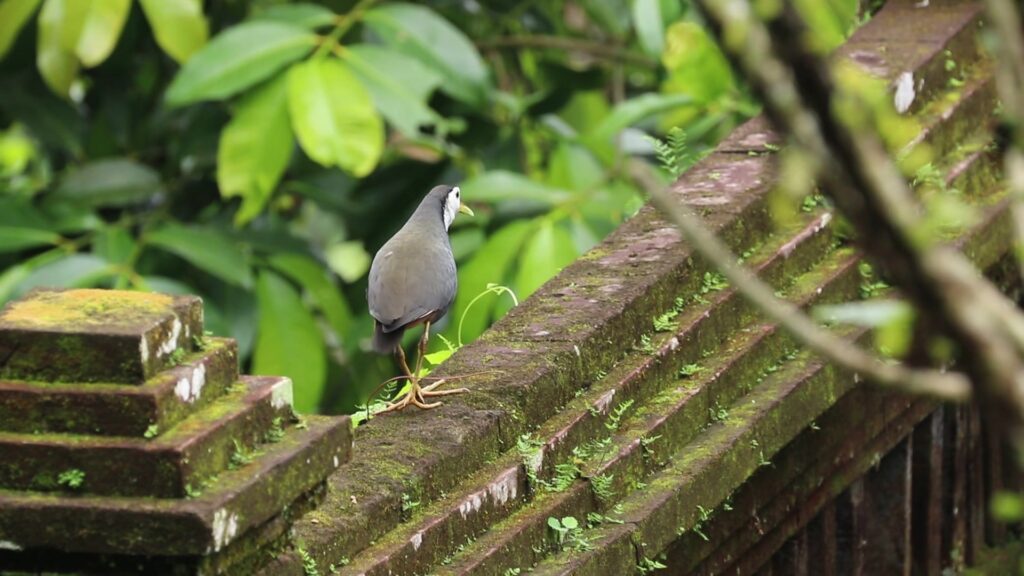
Amaurornis phoenicurus, commonly known as the white-breasted waterhen, is a medium-sized waterbird belonging to the family Rallidae within the order Gruiformes. It is widely distributed across South and Southeast Asia, extending into parts of East Asia and the Greater Sunda Islands. This species is especially recognizable by its contrasting dark gray body, white face and breast, and reddish legs. Unlike many secretive members of the rail family, the white-breasted waterhen frequently ventures into open areas and is often observed walking along pond margins, drainage channels, rice fields, and marshy ground. Its adaptability has enabled it to survive in both natural wetlands and human-modified landscapes.
The white-breasted waterhen has a compact body, a short tail, rounded wings, and long legs with elongated toes. Adults generally have dark slate-gray to blackish plumage over the head, neck, breast sides, and upperparts, contrasting sharply with the white forehead, cheeks, throat, and central breast. The lower belly and undertail region are typically brownish or chestnut-colored, while the legs and feet are reddish. Its bill is yellowish to greenish, often with a reddish base. Juveniles are usually browner and less sharply patterned than adults, with the characteristic white breast becoming more distinct as they mature. These contrasting features make the species relatively easy to identify in suitable light.
The species has a broad geographical range that includes the Indian subcontinent, Sri Lanka, southern China, mainland Southeast Asia, and much of the Malay Archipelago. It occurs in countries such as India, Bangladesh, Nepal, Myanmar, Thailand, Cambodia, Vietnam, Malaysia, Indonesia, and the Philippines, with its precise distribution varying across islands and regional populations. The white-breasted waterhen inhabits tropical and subtropical environments where shallow water and dense vegetation provide feeding and nesting opportunities. It is common in many lowland areas and can occur from coastal wetlands to inland freshwater habitats.
Wetlands are its principal habitat, including marshes, swamps, ponds, lakeshores, river margins, flooded grasslands, and mangroves. It is also frequently found in rice paddies, irrigation ditches, village ponds, gardens, and urban parks with suitable vegetation. The species favors areas where shallow water is interspersed with grasses, reeds, shrubs, or other cover. Such habitats offer abundant food and provide escape routes when predators or people approach. Although it can tolerate disturbed environments, it still depends on access to water, suitable nesting cover, and sufficient food resources.
The white-breasted waterhen is generally active during daylight, especially in the early morning and late afternoon, although it may forage at other times. It walks confidently over muddy ground, through grasses, and across floating vegetation, using its long toes to maintain stability on soft surfaces. When disturbed, it often runs rapidly into dense cover, sometimes flicking its short tail as it moves. It can swim and fly when necessary, but it frequently prefers to escape on foot rather than take flight. Its calls are loud and varied, including harsh squawks, clucks, and repeated notes that can carry across wetlands, particularly during territorial or breeding activity.
Its diet is omnivorous and includes insects, worms, snails, crustaceans, small fish, frogs, seeds, grains, shoots, and other plant material. It commonly searches for food by walking slowly through shallow water and wet vegetation, picking small animals from the surface or probing among leaves and mud. In agricultural areas, it may feed in rice fields and other cultivated plots, where insects and fallen grains are readily available. This flexible diet helps the species exploit seasonal changes in food availability and contributes to its success in landscapes altered by humans.
Breeding behavior is closely associated with the availability of suitable wetland vegetation and sheltered nesting sites. The breeding season varies geographically and is often influenced by rainfall and local water conditions. In many tropical regions, nesting activity increases during or after periods when water and vegetation are abundant. The pair typically builds a bulky, cup-shaped nest from grasses, reeds, and other plant material, placing it among dense vegetation, low shrubs, or reeds near water. The nest is concealed to reduce the risk of discovery by predators.
The female usually lays several eggs, which are incubated by the parents. Both adults generally contribute to caring for the nest and protecting the young. The chicks hatch covered in dark down and are able to move soon after emerging from the eggs. They follow their parents through vegetation while learning to forage, and the adults provide protection from predators and other dangers. This early mobility is advantageous in wetlands, where flooding, changing water levels, and predators can threaten nests and young birds. Family groups may remain together for a period after hatching, depending on local conditions.
Ecologically, the white-breasted waterhen contributes to the regulation of invertebrate populations and participates in the movement of seeds through its feeding activities. Its diet includes many insects and other small animals that form part of wetland food webs. At the same time, its eggs, chicks, and adults can be preyed upon by snakes, birds of prey, and various mammals. By occupying both natural and artificial wetlands, it forms part of the ecological community found in agricultural and residential landscapes. Its presence in an area often reflects the availability of shallow water and protective vegetation, although it is not by itself a definitive indicator of wetland health.
The white-breasted waterhen is generally considered adaptable and widespread, but local populations can be affected by wetland destruction, water pollution, pesticide exposure, and the removal of dense waterside vegetation. Drainage and intensive development may eliminate breeding areas, while contaminated water can reduce food availability or affect the birds indirectly through the food chain. In some regions, hunting and disturbance may also pose localized threats. Maintaining vegetated pond margins, protecting marshes, and managing agricultural wetlands in ways that preserve habitat diversity can help support the species.
Overall, Amaurornis phoenicurus is a characteristic Asian wetland bird distinguished by its bold white breast, dark body, reddish legs, and loud vocalizations. Its adaptable behavior and varied diet allow it to thrive in a wide range of freshwater habitats, including rice fields and urban wetlands. Although it is often overlooked beside more conspicuous waterbirds, the white-breasted waterhen plays a meaningful role in wetland food webs and demonstrates how certain native birds can coexist with human activity when suitable habitat remains available.