

Jewels (Family Chlorocyphidae)
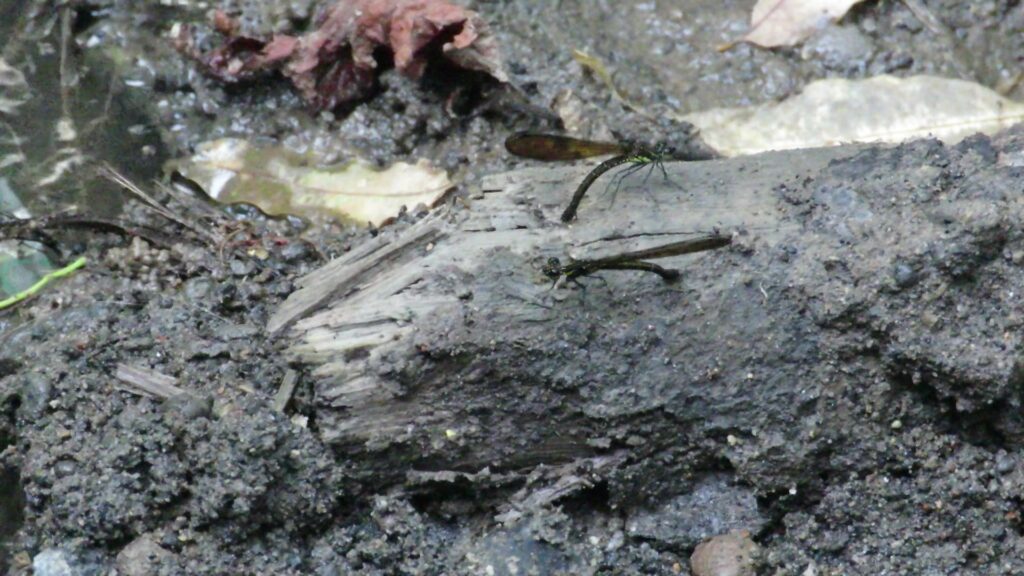
The family Chlorocyphidae is a group of damselflies belonging to the order Odonata, which also includes dragonflies. Commonly known as jewel damselflies, members of this family are renowned for their brilliant metallic colors, striking wing patterns, and distinctive courtship displays. They are primarily distributed across tropical and subtropical regions of Africa and Asia, with their greatest diversity occurring in South and Southeast Asia. These damselflies are closely associated with freshwater environments, particularly flowing streams and rivers, where their larvae develop in aquatic habitats.
Chlorocyphidae damselflies are generally small to medium-sized insects with compact bodies, relatively broad heads, and wings that are often held together above or near the body when resting. Their coloration can include iridescent green, blue, turquoise, red, orange, and black, frequently arranged in contrasting patterns. In many species, males are especially colorful, while females tend to be less conspicuous and may display brownish, greenish, or metallic tones. However, the degree of sexual dimorphism varies among species. The reflective appearance of these insects is often produced by microscopic structural features of the body surface rather than pigmentation alone.
The wings of jewel damselflies are an important feature for identification. They may be transparent, tinted, or marked with dark patches, and their venation provides useful characteristics for distinguishing species. Compared with many slender damselflies, chlorocyphids often have a relatively robust appearance and a distinctive posture when perched. Their large compound eyes provide a broad field of vision, helping them detect prey, rivals, and potential mates. Their legs are adapted for grasping and holding small insects rather than for walking over long distances.
The family occurs mainly in the Afrotropical and Oriental regions, including tropical Africa, the Indian subcontinent, Sri Lanka, southern China, mainland Southeast Asia, and the islands of the Malay Archipelago. Many species are restricted to particular river systems or geographical regions, making the family an interesting subject for studies of biogeography and freshwater biodiversity. In Southeast Asia, chlorocyphids may inhabit shaded forest streams, rocky creeks, and rivers bordered by dense vegetation. Their distribution is closely associated with the availability of suitable aquatic breeding sites and the surrounding terrestrial vegetation.
Adult chlorocyphids are commonly found along streams and rivers, where they perch on rocks, exposed roots, branches, and leaves near the water. Males of many species are territorial and may repeatedly return to favored perching sites from which they watch for females and rival males. Their courtship behavior can be visually elaborate, involving wing movements, body positioning, and the display of brightly colored body parts. These behaviors help individuals recognize potential mates and communicate territorial ownership. Although many species favor shaded streams, some can occur in more open freshwater habitats where appropriate vegetation and breeding conditions remain available.
Like other odonates, Chlorocyphidae are predatory throughout their life cycle. Adults capture small flying insects, including mosquitoes, midges, flies, and other tiny arthropods. They typically wait on a perch before launching short, rapid flights to intercept prey. Their vision and maneuverability enable them to locate and capture small insects in complex environments along stream margins. By feeding on flying invertebrates, adult jewel damselflies contribute to the regulation of insect populations in freshwater ecosystems.
The immature stages of chlorocyphids are aquatic nymphs, also called larvae. Depending on the species, they inhabit submerged roots, stones, leaf litter, and other structures in flowing water. Their flattened bodies and specialized legs help them remain among the stream substrate, where they hunt small aquatic invertebrates. Larvae may feed on insect larvae, tiny crustaceans, and other organisms that they can capture. Their development involves a series of molts, after which the mature nymph leaves the water and emerges as a winged adult. The duration of larval development varies with species, temperature, food availability, and water conditions.
Reproduction usually takes place near suitable freshwater habitats. After courtship and mating, females deposit eggs in or near water, often using plant tissue, submerged vegetation, or other suitable surfaces. In many damselflies, the female inserts eggs into plant material or deposits them in aquatic substrates, although the exact method varies among species. The eggs hatch into aquatic larvae, which grow through successive developmental stages before emerging as adults. The presence of appropriate stream conditions is essential for successful reproduction and recruitment of new generations.
Chlorocyphidae play an important role in freshwater food webs. Their aquatic larvae consume small invertebrates and may themselves be eaten by fish, aquatic insects, and other predators. Adults serve as prey for spiders, birds, and larger predatory insects. Because many species depend on flowing water and intact streamside vegetation, they can be affected by habitat degradation, pollution, sedimentation, and changes in stream flow. Deforestation may increase water temperature and sediment runoff, while dams and water extraction can alter the conditions required for larval development. These pressures can be particularly serious for species with small geographical ranges.
Conservation of jewel damselflies depends largely on protecting the freshwater environments in which they reproduce. Maintaining natural stream flow, preserving riparian vegetation, reducing chemical pollution, and preventing excessive sedimentation can help sustain suitable habitats. Surveys of adult damselflies and aquatic larvae can also provide useful information about the condition of local freshwater ecosystems. However, species differ in their sensitivity to environmental changes, and the presence or absence of chlorocyphids should be interpreted alongside other ecological evidence.
The family Chlorocyphidae represents a distinctive and visually striking component of tropical freshwater biodiversity. Its members combine brilliant coloration, specialized courtship behavior, aerial predation, and aquatic larval development. Although their small size may make them easy to overlook, jewel damselflies are important predators and indicators of the ecological conditions found along streams and rivers. Their diversity and specialized habitat requirements make them valuable subjects for research into insect evolution, freshwater ecology, and the conservation of tropical aquatic environments.