

Asian Sunbeam Snake (Xenopeltis unicolor)
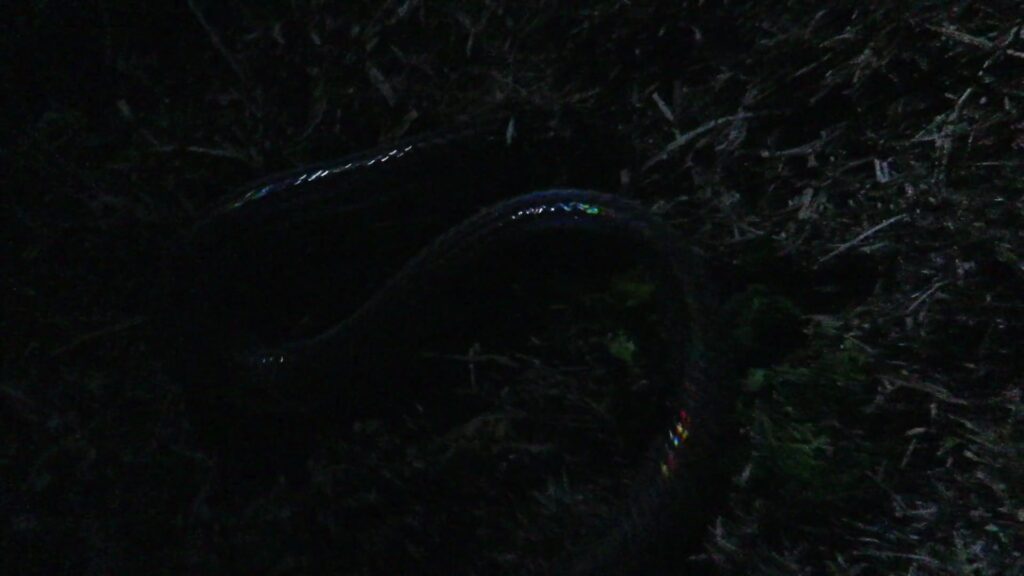
Xenopeltis unicolor, commonly known as the common sunbeam snake, is a nonvenomous snake belonging to the family Xenopeltidae and the order Squamata. It is renowned for its smooth, glossy scales that produce a brilliant rainbow-like iridescence when exposed to sunlight. Native to South and Southeast Asia, this secretive reptile is adapted to a largely ground-dwelling and burrowing lifestyle, spending much of its time concealed beneath soil, leaf litter, fallen logs, and other forms of ground cover.
The common sunbeam snake has a long, cylindrical, muscular body covered with smooth, tightly arranged scales. Its upper surface is typically dark brown, blackish, or purplish, while the underside is generally lighter, ranging from grayish to pale cream. Its most remarkable feature is the intense iridescence of its scales, which can reflect blue, green, violet, and rainbow-like colors as the angle of light changes. This effect results from the microscopic structure of the scales rather than from bright pigments alone.
The head is relatively small, flattened, and only slightly distinct from the neck. Its eyes are small in proportion to the head, and its body is streamlined to facilitate movement through loose soil and narrow spaces. The smooth scales reduce friction as the snake moves beneath vegetation and through the ground. Its strong, flexible body allows it to push through leaf litter, soft soil, and other materials while searching for shelter or prey.
Xenopeltis unicolor occurs across a broad region of South and Southeast Asia, including parts of northeastern India, Bangladesh, Myanmar, Thailand, Cambodia, Laos, Vietnam, Malaysia, Singapore, and Indonesia. Its habitats include tropical forests, secondary woodland, plantations, gardens, agricultural areas, and other environments with suitable ground cover. Moist soil and sheltered spaces are particularly important because they provide opportunities for burrowing, protection from predators, and access to prey.
This species is predominantly nocturnal or crepuscular, meaning it is often active at night or during periods of low light. During the daytime, it usually remains hidden beneath rocks, fallen logs, leaf litter, or underground. It may become more visible after rainfall, when humid conditions encourage movement and increase the availability of prey near the surface. Despite its striking appearance, it is rarely observed because of its secretive habits.
The common sunbeam snake is carnivorous and feeds on a variety of small vertebrates, including frogs, lizards, other snakes, and small mammals. It searches for prey among vegetation, beneath debris, and within concealed spaces. As a nonvenomous snake, it relies on its muscular body and jaws to restrain prey before swallowing it whole. Its burrowing behavior allows it to investigate sheltered areas where prey animals may hide.
Although Xenopeltis unicolor is generally not aggressive, it may bite defensively when captured or handled. It can also release an unpleasant-smelling secretion when threatened. Its glossy scales and unusual appearance sometimes lead people to mistake it for a dangerous species, but it lacks specialized venom-delivery adaptations and is not considered medically significant to humans. Nevertheless, wild snakes should be left undisturbed, as unnecessary handling can injure both the animal and the person.
Reproduction is oviparous, meaning that females lay eggs rather than giving birth to live young. The eggs are deposited in sheltered locations where moisture and temperature support embryonic development. After hatching, the young snakes are independent and possess the characteristic iridescent scales of adults. Details of breeding seasons, clutch sizes, and incubation periods may vary geographically, and some aspects of the species’ reproductive biology remain insufficiently documented.
Ecologically, Xenopeltis unicolor plays a role in controlling populations of small vertebrates and contributes to the balance of terrestrial food webs. It may itself be preyed upon by larger snakes, birds of prey, and other predators. Its ability to occupy forested areas as well as some human-modified habitats allows it to persist in a variety of environments, provided that suitable shelter and food remain available.
The species may be affected by deforestation, intensive agricultural development, soil disturbance, road mortality, and collection for the exotic pet trade. Because it spends much of its time underground or beneath ground cover, population changes can be difficult to detect. Preserving natural vegetation, maintaining suitable ground-level habitats, and reducing unnecessary killing of snakes are important measures for supporting local populations.
Overall, Xenopeltis unicolor is a distinctive Asian snake recognized for its iridescent scales, cylindrical body, burrowing habits, and nonvenomous nature. Its specialized adaptations allow it to thrive in warm, humid environments where suitable soil and ground cover are available. Although secretive and seldom encountered, the common sunbeam snake is an important predator in its ecosystem and a remarkable example of the structural diversity found among snakes.