

Lutungs (Genus Trachypithecus)
- Animals(Kingdom Animalia)
The genus Trachypithecus comprises a diverse group of Asian colobine monkeys commonly known as lutungs or leaf monkeys. These primates belong to the family Cercopithecidae, subfamily Colobinae, and are native to South and Southeast Asia, including parts of the Indian subcontinent, southern China, mainland Southeast Asia, and the Malay Archipelago. They are primarily arboreal mammals adapted to life in forests, where they feed mainly on leaves and other plant materials. Recognized for their slender bodies, long tails, expressive faces, and often distinctive coat colours, members of Trachypithecus occupy an important ecological position as specialized herbivores in tropical and subtropical forest ecosystems.
Members of Trachypithecus generally have slender bodies, relatively long limbs, and long tails that assist with balance during climbing and leaping. Their body size and appearance vary among species, with adult fur ranging from grey and brown to black, golden, or orange. Some species have contrasting facial markings, pale rings around the eyes, lighter cheek fur, or distinctive patterns on the forehead and crown. Their faces are usually dark or lightly coloured depending on the species, and their eyes are adapted for observing their surroundings in the forest canopy. These variations in fur and facial appearance help distinguish species and reflect the evolutionary diversity of the genus.
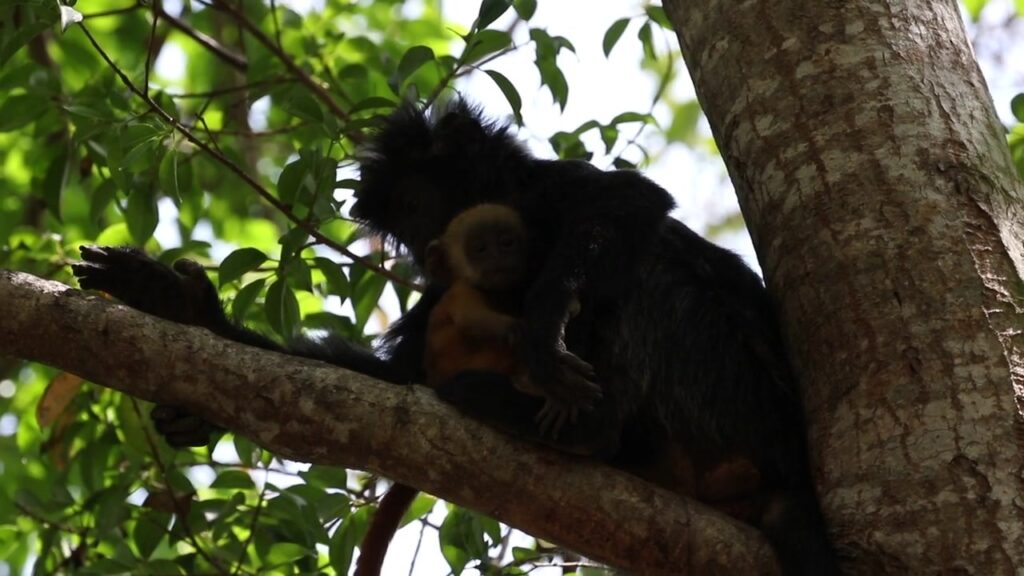
One of the most striking characteristics of Trachypithecus is the difference between the appearance of infants and adults in several species. Newborns may have bright orange, golden, or yellowish coats that contrast sharply with the darker or greyish fur of mature individuals. As the infants grow, their coat gradually changes toward the adult coloration. This conspicuous juvenile coloration is thought to facilitate recognition and social interactions within groups, although its precise function may differ among species. The contrast between infant and adult appearance is particularly notable in several Southeast Asian lutungs and is a distinctive feature of their life history.
The limbs and hands of Trachypithecus are adapted for movement through trees. Their long arms and legs enable them to climb trunks, traverse branches, and leap between neighbouring trees. Their elongated tails function primarily as balancing structures during locomotion and when resting on narrow branches. Many species spend most of their lives in the canopy or middle layers of the forest, descending to the ground only occasionally. Their agility helps them move through complex vegetation while searching for food and avoiding potential predators. The degree to which they use different forest layers depends on species, habitat structure, and the distribution of food resources.
The geographic distribution of Trachypithecus extends across a broad region of Asia, with different species occupying distinct ranges. They occur in tropical rainforests, seasonal deciduous forests, evergreen woodlands, limestone forests, mangroves, and montane habitats. Some species are associated with lowland forests, while others inhabit hilly or mountainous regions. Several have restricted distributions on islands or within particular river basins and forest blocks. Although many lutungs depend on relatively continuous tree cover, some can survive in secondary forests and fragmented landscapes if adequate food and shelter remain available. Their distribution is influenced by climate, elevation, vegetation type, and geographic barriers that separate populations.
The diet of Trachypithecus consists primarily of leaves, including young foliage, mature leaves, buds, shoots, and occasionally flowers, fruits, and seeds. Many species select young leaves because they are generally easier to digest and may contain higher concentrations of certain nutrients. Fruits and other plant parts supplement the diet when available, but leaves remain a major food source for most members of the genus. Like other colobine monkeys, Trachypithecus possesses a complex, multi-chambered stomach containing microorganisms that ferment fibrous plant material. This adaptation allows them to digest cellulose and obtain nutrients from foliage that is difficult for many other primates to process. Their feeding patterns and resting periods are closely linked to the time required for digestion.
Members of Trachypithecus commonly live in social groups, although group composition and size vary among species. Groups may contain several adult females, their offspring, and one or more adult males. Individuals maintain social relationships through grooming, vocal communication, facial expressions, and body postures. Grooming helps strengthen social bonds and reduce tension, while vocalizations allow group members to maintain contact in dense vegetation. Some species defend territories or regularly use particular feeding areas. Social structure is influenced by food availability, predation risk, habitat quality, and interactions with neighbouring groups.
Reproduction in Trachypithecus typically involves the birth of a single infant after a gestation period lasting several months. Females provide most of the parental care, nursing their young and protecting them as they develop the strength and coordination required for independent movement. In some species, females other than the mother may handle or carry infants, a behaviour often described as allomaternal care. Young lutungs gradually learn which plants are suitable for feeding and how to move safely through the canopy. The timing of sexual maturity and reproductive intervals varies among species and may be influenced by nutrition, environmental conditions, and social organization.
The genus plays an important role in forest ecosystems through its feeding activities and interactions with other animals. By consuming leaves, buds, and shoots, lutungs influence vegetation growth and may affect the composition of forest understories and canopy plants. Species that consume fruits can also contribute to seed dispersal, although the importance of this role differs among species. Members of Trachypithecus serve as prey for predators such as leopards, large pythons, and certain birds of prey in regions where these animals coexist. Their dependence on trees makes them vulnerable to habitat degradation, especially when forest fragmentation disrupts movement between feeding sites and separates populations.
Taxonomic research has revealed substantial diversity within Trachypithecus. Species are distinguished using features such as coat colour, facial markings, skull morphology, body proportions, geographic distribution, and genetic characteristics. Molecular studies have helped clarify relationships among populations and have led to changes in the classification of some species. The boundaries between closely related lutungs can be difficult to establish because certain species exhibit similar external characteristics or geographical variation. As a result, the number of recognized species and their precise relationships may differ among taxonomic authorities.
Conservation concerns affect many members of Trachypithecus. Deforestation, agricultural expansion, plantation development, mining, road construction, and urban growth have reduced or fragmented suitable habitats across parts of Asia. Hunting and illegal wildlife trade also threaten some species, while small populations isolated by habitat loss may be vulnerable to further decline. Species with restricted island or mountain distributions are especially susceptible to environmental change. Conservation efforts include protecting forest reserves, restoring degraded habitats, maintaining forest corridors, enforcing wildlife protection laws, and monitoring population trends. Long-term conservation depends on preserving connected habitats and reducing human pressures on the remaining populations.
Overall, Trachypithecus is a distinctive genus of Asian leaf monkeys characterized by its arboreal lifestyle, specialized digestive system, varied coat colours, and complex social behaviour. Its members have evolved adaptations that allow them to exploit foliage as a major food resource while navigating the forest canopy. Through their feeding habits and interactions with predators and other organisms, they contribute to the ecological functioning of tropical and subtropical forests. Protecting their habitats and populations is essential for conserving the remarkable diversity of Asian primates.