

Javan Lutung (Trachypithecus auratus)
- Animals(Kingdom Animalia)
Trachypithecus auratus, commonly known as the Javan langur or ebony langur, is a species of Old World monkey belonging to the family Cercopithecidae, subfamily Colobinae, and genus Trachypithecus. It is native to the Indonesian islands of Java and Bali, where it inhabits tropical forests and other wooded environments. This primate is recognized for its slender body, long tail, dark adult coat, and distinctive coloration in its younger stages. As a specialized leaf-eating monkey, it possesses digestive adaptations that enable it to obtain nutrients from fibrous plant material. Its ecological importance and restricted geographic distribution make it a notable component of Indonesia’s native mammal diversity.
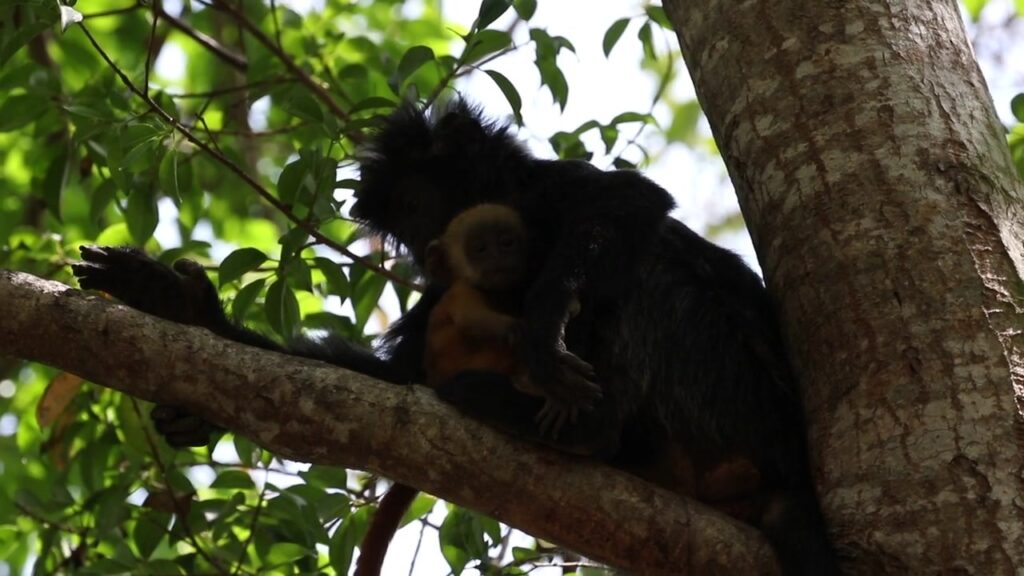
The Javan langur has a slender body, relatively long limbs, and a long, narrow tail that assists with balance during movement through trees. Adults commonly have dark brown, charcoal-grey, or nearly black fur, although coloration varies among individuals and populations. Some animals exhibit lighter brown or golden tones, particularly in parts of the coat. The face is generally dark and relatively hairless, with prominent eyes and a muzzle suited to feeding on vegetation. Its body proportions are adapted to arboreal locomotion, allowing it to climb branches, leap between trees, and travel through dense forest vegetation.
One of the most distinctive features of Trachypithecus auratus is the contrasting appearance of its infants. Young individuals are typically born with bright orange or yellowish-orange fur, which stands out against the darker coloration of adults. As they mature, their coats gradually change to the darker adult pattern. This striking difference is a characteristic feature of the species and may facilitate recognition of infants within social groups. The timing and extent of the colour transition can vary, and individual coat coloration is not always uniform across the species.
The natural distribution of the Javan langur is centred on Java and Bali in Indonesia. It occupies a variety of forest habitats, including tropical rainforests, monsoon forests, evergreen woodlands, and secondary forests. It may also occur in wooded areas near agricultural landscapes when sufficient tree cover and food resources remain available. The species can inhabit lowland forests as well as hilly and mountainous regions, depending on local conditions. Its distribution is influenced by forest structure, climate, elevation, and the availability of suitable vegetation. Because its native range is geographically limited, habitat changes across these islands can have a substantial effect on local populations.
The diet of Trachypithecus auratus consists primarily of leaves, young shoots, buds, flowers, and other plant material. Fruits and seeds may supplement its diet when available, but foliage is an important food resource throughout much of the year. The species often selects young leaves because they tend to be less fibrous and easier to digest than mature foliage. Like other colobine monkeys, the Javan langur possesses a complex, multi-chambered stomach containing microorganisms that help break down cellulose and ferment plant material. This digestive adaptation allows it to obtain nutrients from leaves that many other primates cannot efficiently utilize. Its feeding preferences change according to the availability and nutritional quality of plants in its habitat.
The Javan langur is predominantly arboreal and spends much of its time in the forest canopy and middle layers of vegetation. Its long limbs and tail enable it to climb, balance, and leap between branches while searching for food. Although it may occasionally descend to the ground, trees provide its main feeding and resting sites, as well as protection from many terrestrial threats. Activity often occurs during daylight hours, with feeding, movement, resting, and social interactions forming the main components of its daily routine. The amount of time devoted to each activity depends on food availability, weather, disturbance, and the structure of the surrounding habitat.
Social behaviour in Trachypithecus auratus involves group living, although group size and composition vary with local conditions. Groups commonly include adult females, their offspring, and one or more adult males. Individuals communicate through vocalizations, facial expressions, body postures, and physical contact. Grooming helps maintain social bonds and can reduce tension between group members. Young monkeys learn feeding and movement behaviours by observing adults, while interactions between females and infants are particularly important during early development. Group members may also use calls to maintain contact when vegetation obscures visibility or when individuals become separated during feeding.
Reproduction generally results in the birth of a single infant following a gestation period lasting several months. Females provide most parental care, nursing their young and protecting them as they develop the strength and coordination needed for independent movement. The bright orange infant coat is especially conspicuous during this early stage of life. As the infant grows, it gradually begins to move more independently and learns which plants are suitable for feeding. Other group members may show interest in infants, and in some circumstances females may participate in limited allomaternal care. The timing of breeding and the interval between births can vary according to environmental conditions, nutrition, and social circumstances.
Ecologically, the Javan langur plays an important role as a herbivore within Indonesia’s forest ecosystems. Its consumption of leaves and shoots can influence plant growth and vegetation structure, while the ingestion of fruits may contribute to seed dispersal. As part of the forest food web, it also represents a potential prey species for large predators, including leopards where their distributions overlap. Its dependence on forest cover makes it sensitive to changes in canopy structure and habitat connectivity. The loss of continuous forest can restrict movement between feeding areas, isolate groups, and reduce access to suitable food and shelter.
The conservation of Trachypithecus auratus is affected by deforestation, habitat fragmentation, agricultural expansion, infrastructure development, hunting, and illegal capture. Forest conversion can reduce the availability of suitable habitat on Java and Bali, while isolated populations may face additional risks from small population size and limited connectivity. Although the species can use some secondary or disturbed forests, this flexibility does not eliminate its dependence on adequate tree cover and food resources. Conservation measures include protecting remaining forests, restoring degraded habitats, maintaining connections between forest patches, and preventing the illegal capture and trade of wild monkeys. Monitoring populations and reducing human disturbance are important for understanding and supporting its long-term survival.
Overall, Trachypithecus auratus is a distinctive Indonesian primate characterized by its dark adult coat, orange-furred infants, arboreal lifestyle, and specialized leaf-based diet. Its adaptations allow it to thrive in a variety of forest environments, where it contributes to vegetation dynamics and the broader ecological relationships that sustain tropical ecosystems. As a native species of Java and Bali, it forms an important part of Indonesia’s natural heritage. Preserving its remaining habitats and maintaining viable wild populations are essential for ensuring that the Javan langur continues to survive in its native range.