

Muntjacs (Genus Muntiacus)
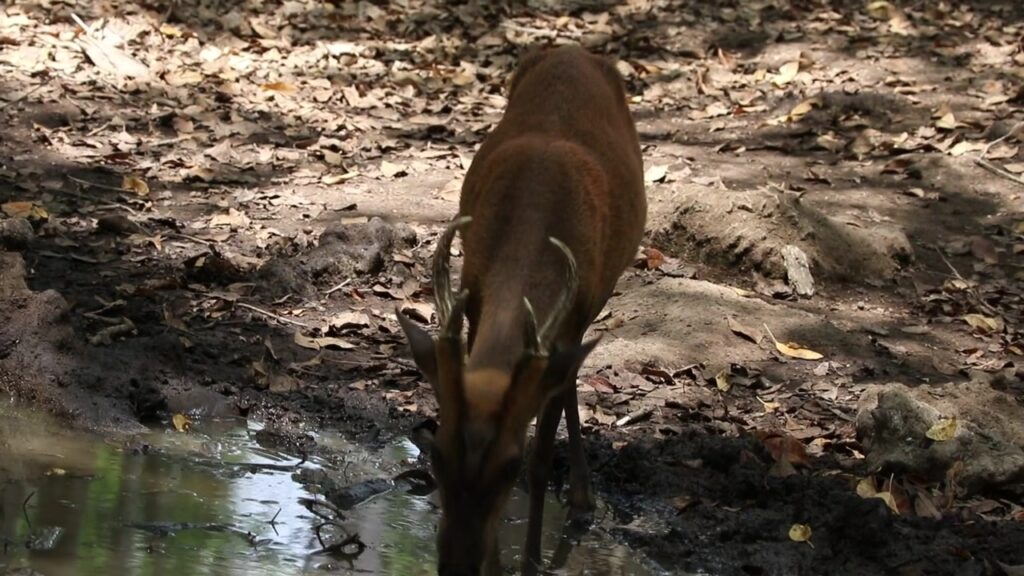
The genus Muntiacus comprises the muntjacs, a group of small to medium-sized deer belonging to the family Cervidae and subfamily Cervinae. These mammals are native primarily to South, East, and Southeast Asia, where they inhabit tropical forests, subtropical woodlands, dense undergrowth, and forest margins. Often called barking deer because of the alarm calls produced by several species, muntjacs are notable for their compact bodies, short antlers, prominent canine teeth, and secretive behaviour. Their ability to navigate dense vegetation and exploit a wide variety of plant resources has enabled them to occupy diverse habitats, from lowland rainforests to mountainous woodland.
Members of Muntiacus generally have a sturdy body, slender legs, a relatively short tail, and a pointed muzzle. Their coat colour varies among species, ranging from reddish brown and chestnut to yellowish brown, greyish brown, and darker shades. The underside is often paler, while the forehead and face may feature contrasting dark or light markings. Their large ears and well-developed senses help them detect potential predators and other disturbances in the forest. Although muntjacs are relatively small compared with deer such as the red deer or moose, their muscular limbs and flexible movements allow them to move quickly through tangled vegetation.
One of the most distinctive characteristics of Muntiacus is the unusual structure of the male head. Males typically possess short, unbranched antlers that grow from elongated bony pedicles on the skull. These pedicles can extend conspicuously above the forehead, making the antlers appear higher than their actual length suggests. Male muntjacs also possess enlarged upper canine teeth that project downward from the mouth and may be used in aggressive encounters. These teeth are particularly important in distinguishing muntjacs from many other deer, which rely more heavily on antlers during male competition. Females generally lack fully developed antlers and have shorter pedicles, although details differ among species.
The genus is distributed across a broad region of Asia, including parts of the Indian subcontinent, southern China, mainland Southeast Asia, and the Malay Archipelago. Different species occupy distinct geographic ranges, and some are restricted to particular islands or mountain regions. Their habitats include evergreen rainforests, deciduous forests, bamboo thickets, secondary woodland, scrub, and forest edges. Many muntjacs prefer areas with dense ground cover that provide shelter from predators, but some species can persist in disturbed habitats and fragmented landscapes when sufficient vegetation remains. Their distribution is influenced by climate, topography, food availability, and the degree of human disturbance.
Muntjacs are herbivorous browsers that feed on leaves, young shoots, grasses, herbs, buds, fallen fruits, and other plant material. They often select tender vegetation with high nutritional value and may change their feeding preferences according to seasonal availability. Fallen fruits and seeds can become important food sources when abundant. Like other ruminants, muntjacs possess a multi-chambered stomach in which microorganisms assist in breaking down fibrous plant matter. This digestive adaptation allows them to obtain nutrients from a wide range of vegetation. Their relatively small size and flexible diet enable them to forage in forest understories where food resources are distributed unevenly.
Most muntjacs are solitary or occur in pairs rather than forming large herds. Individuals often use relatively small home ranges and move along familiar routes through dense vegetation. Scent marking, rubbing, scraping, and vocal signals help communicate information about territory and reproductive condition. When alarmed, a muntjac may remain motionless before suddenly retreating into cover. Several species produce sharp, repeated barking calls when disturbed, especially when they detect a possible predator. These calls are responsible for the common name barking deer and can serve as warning signals within their surroundings. Muntjacs are often most active during dawn, dusk, or nighttime, although activity varies according to habitat, weather, and human disturbance.
Reproduction in Muntiacus is relatively flexible compared with that of many temperate deer. Several species can breed throughout much of the year when environmental conditions are favourable, although seasonal patterns may occur in particular populations. After mating, the female gives birth to a single fawn following a gestation period lasting several months. Newborn fawns usually remain concealed in dense vegetation during their early development, reducing the risk of detection by predators. The mother returns periodically to nurse and care for the young. As the fawn grows, it becomes increasingly mobile and gradually learns to recognize food sources, shelter, and potential threats. The age at sexual maturity and reproductive timing vary among species and depend partly on nutrition and environmental conditions.
The ecological role of Muntiacus extends beyond its importance as a forest herbivore. By browsing on seedlings, leaves, and shoots, muntjacs influence the growth and composition of understory vegetation. Their feeding may affect forest regeneration, particularly where populations are abundant. They may also consume fallen fruits and contribute to seed movement, although their effects on seed dispersal depend on the plants involved and how the seeds are handled during feeding and digestion. Muntjacs serve as prey for larger carnivores, including leopards, tigers, and dholes in regions where these animals coexist. They therefore form an important link between plant communities and higher levels of the food web.
The genus Muntiacus is scientifically notable for its unusual chromosomal diversity. Different muntjac species can possess strikingly different chromosome numbers, making the group an important subject in studies of mammalian chromosome evolution, genome organization, and speciation. Despite their similar general body form, muntjac species differ in morphology, genetics, geographic distribution, and habitat preferences. Their classification has changed as molecular studies have clarified relationships among populations and species. Some forms that were once considered geographic variants have received greater taxonomic recognition, while other classifications continue to be debated. As a result, the exact number of recognized species depends on the taxonomic authority being followed.
Conservation concerns affecting Muntiacus include habitat loss, fragmentation, hunting, and the expansion of agriculture and infrastructure. Some species are relatively widespread and adaptable, while others have restricted distributions and are more vulnerable to environmental change. Forest clearance can reduce the availability of feeding sites and protective cover, while hunting may cause substantial local declines. Small, isolated populations may also face additional risks from habitat degradation and reduced genetic connectivity. Conservation measures include protecting forest habitats, maintaining connections between fragmented landscapes, enforcing wildlife regulations, and conducting population surveys. Species-specific assessment is essential because conservation status and threats vary considerably across the genus.
Overall, Muntiacus is a distinctive genus of Asian deer characterized by its compact body, short antlers, enlarged canine teeth in males, flexible feeding habits, and secretive forest-dwelling behaviour. Its members are well adapted to life in dense vegetation and contribute to ecological processes through browsing, interactions with predators, and participation in forest food webs. Their unusual chromosomal diversity also provides valuable insights into mammalian evolution. Protecting muntjacs and their habitats is important for maintaining the biodiversity and ecological functioning of Asian forests.