

Southern Red Muntjac (Muntiacus muntjak)
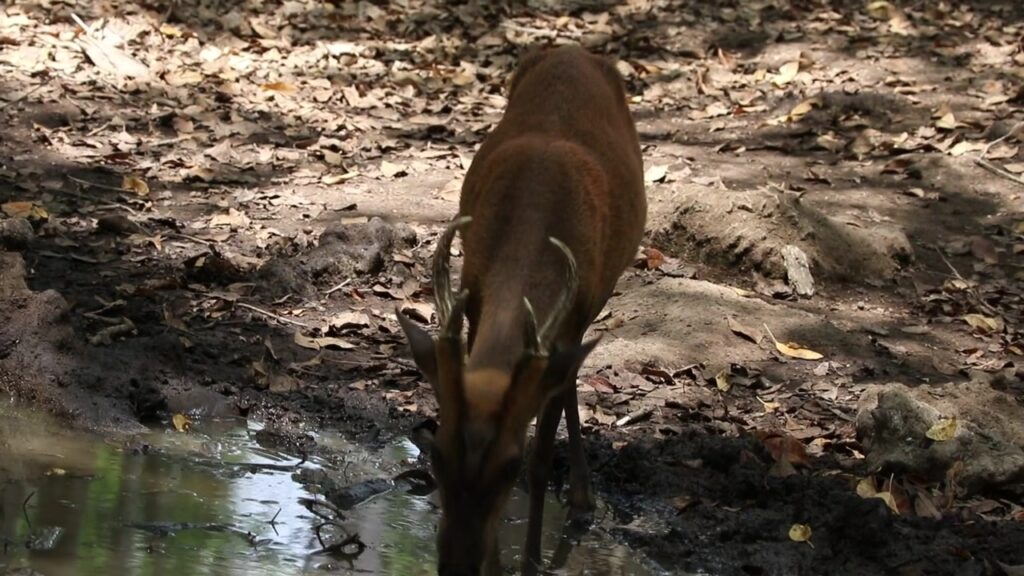
Muntiacus muntjak, commonly known as the Indian muntjac or barking deer, is a small deer belonging to the family Cervidae, subfamily Cervinae, and genus Muntiacus. It is native to South and Southeast Asia and is recognized for its reddish-brown coat, short antlers in males, prominent canine teeth, and distinctive barking calls. This species inhabits a variety of forest environments, including tropical rainforests, deciduous woodlands, bamboo thickets, and forest edges. Its adaptability, secretive behaviour, and flexible feeding habits allow it to survive in diverse landscapes, from dense natural forests to areas modified by human activity.
The Indian muntjac has a compact, muscular body, slender legs, a relatively short tail, and a pointed muzzle. Its coat is typically reddish brown or chestnut, although the colour may vary geographically and seasonally. The underside is generally paler, while the face may feature darker markings around the forehead and muzzle. Its large ears and prominent eyes help it detect sounds and movements in the surrounding vegetation. Compared with larger deer, the Indian muntjac has a relatively small stature, which enables it to move efficiently through dense undergrowth and use narrow pathways beneath the forest canopy.
One of the species’ most distinctive features is the unusual head structure of adult males. Males possess short, usually unbranched antlers supported by elongated bony pedicles that rise from the skull. They also have enlarged upper canine teeth that project downward from the mouth and may be used during aggressive encounters with rivals. These elongated canines are particularly noticeable in males and distinguish muntjacs from many other deer, which rely more heavily on their antlers during competition. Females generally lack fully developed antlers and have shorter pedicles. The combination of small antlers and prominent canine teeth reflects the distinctive evolutionary adaptations of muntjacs.
The Indian muntjac occurs across a broad region of South and Southeast Asia, including parts of the Indian subcontinent and mainland Southeast Asia, with populations also found on several islands in the region. It occupies a wide range of habitats, from lowland tropical forests to hilly and mountainous woodlands. Dense vegetation provides shelter, feeding opportunities, and protection from predators, while forest margins and secondary growth may offer abundant young shoots and other nutritious plant material. Although the species is strongly associated with forested habitats, it can tolerate some degree of habitat disturbance when sufficient vegetation and cover remain available.
The diet of Muntiacus muntjak consists primarily of plant material, including leaves, tender shoots, grasses, herbs, buds, fallen fruits, and young branches. It is mainly a browser, selectively feeding on vegetation that provides suitable nutrients. Fruits and seeds may become important food sources when available, while grasses and other ground-level plants supplement its diet. Like other ruminants, the Indian muntjac has a multi-chambered stomach containing microorganisms that help break down fibrous plant matter. This digestive system enables it to extract nutrients from a variety of vegetation and adjust its feeding behaviour according to seasonal changes in food availability.
The Indian muntjac is generally solitary and secretive, although individuals may occasionally occur in pairs or encounter one another near feeding areas. It moves quietly through forest undergrowth, using familiar trails and sheltered routes between feeding and resting sites. Its activity often increases during dawn, dusk, and nighttime, although local conditions and human disturbance can influence its daily pattern. When alarmed, the animal may freeze briefly before fleeing into dense vegetation. One of its most recognizable behaviours is the production of repeated barking calls when disturbed or when a potential threat is detected. These vocalizations have given the species its common name, barking deer.
Reproduction in the Indian muntjac can occur throughout much of the year, although local populations may show seasonal patterns influenced by climate and food availability. Following mating, the female gives birth to a single fawn after a gestation period of approximately seven months. The newborn is often concealed in dense vegetation during its early development, reducing the likelihood of detection by predators. The mother returns periodically to nurse and care for the young, which gradually becomes more mobile as it grows. The fawn eventually begins accompanying the mother while learning to recognize suitable food sources, sheltered resting places, and potential dangers. Females may reproduce again after successfully raising offspring, allowing populations to recover when environmental conditions are favourable.
Ecologically, Muntiacus muntjak plays an important role as a forest herbivore and a prey species for larger carnivores. Its browsing affects the growth and regeneration of understory plants, particularly seedlings, young shoots, and shrubs. By consuming fallen fruits and other plant material, it may also influence the movement and fate of seeds, although its contribution to seed dispersal varies with the plants involved. The species provides food for predators such as leopards, tigers, and dholes in areas where their ranges overlap. Its abundance can therefore influence predator diets and contribute to the broader balance of forest food webs.
The Indian muntjac is generally adaptable, but its populations can be affected by habitat loss, fragmentation, hunting, and increasing human pressure. Forest clearance for agriculture, settlements, plantations, and infrastructure can reduce suitable habitat and restrict movement between forest patches. Hunting may also cause local declines, particularly where wildlife protection is weak. Nevertheless, the species persists in a range of landscapes and may remain relatively common in suitable habitats. Conservation efforts that protect forest cover, maintain habitat connectivity, regulate hunting, and monitor wildlife populations help support its long-term survival.
Overall, Muntiacus muntjak is a distinctive Asian deer characterized by its compact body, reddish-brown coat, short antlers, enlarged canine teeth in males, and characteristic barking calls. Its flexible diet, largely solitary behaviour, and ability to navigate dense vegetation make it well suited to life in tropical and subtropical forests. As both a browser and a prey animal, it contributes to vegetation dynamics and supports the ecological relationships that sustain forest ecosystems. Its continued survival depends on the preservation of suitable habitats and the responsible management of human interactions with wildlife.