

Subfamily Meloinae
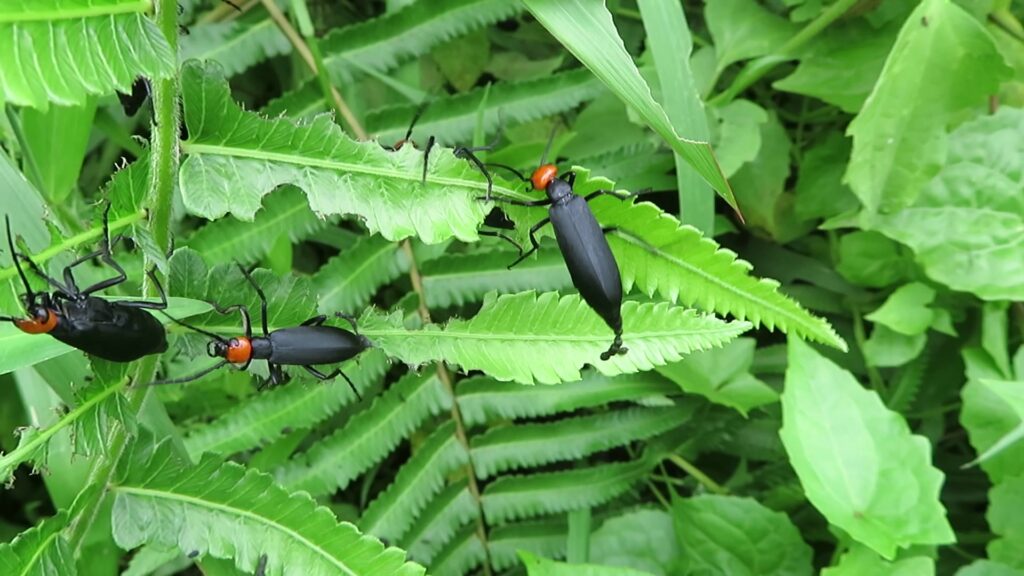
The subfamily Meloinae comprises a group of beetles belonging to the family Meloidae, commonly known as blister beetles. These insects are distributed across many parts of the world and are particularly diverse in warm and temperate regions. Members of Meloinae are notable for their soft-bodied appearance, relatively narrow pronotum, elongated bodies in many species, and defensive chemical secretions containing cantharidin. This compound can cause blistering when it comes into contact with human skin and serves as an important chemical defence against predators. The subfamily includes numerous genera with varied body shapes, colours, life histories, and relationships with flowering plants and other insects.
Adult meloine beetles range considerably in size, colour, and body proportions. Many have elongated, flexible bodies with a distinct head, a relatively narrow thorax, and a broad abdomen. Their elytra, or hardened forewings, may be elongated, shortened, soft, or loosely fitted over the abdomen, depending on the species. Some species are dark brown or black, while others display bright red, orange, yellow, or contrasting patterns that may warn predators of their chemical defences. Certain species have a metallic sheen, whereas others possess a matte surface that helps them blend into vegetation and soil. These differences in appearance are useful for identification but must be considered alongside structural features.
The head of Meloinae bears prominent compound eyes, segmented antennae, and chewing mouthparts adapted for feeding on plant material. Antennal shape varies among genera and may provide useful taxonomic characters. The thorax supports three pairs of legs and the wings, while the abdomen contains the digestive and reproductive organs. In many species, the body covering is relatively soft compared with that of beetles with heavily hardened exoskeletons. The elytra may leave part of the abdomen exposed, giving some blister beetles a distinctive appearance. Such morphological features reflect the diversity of forms that have evolved within the family Meloidae.
Meloinae occurs in a broad range of terrestrial habitats, including grasslands, open woodlands, agricultural fields, scrublands, deserts, and areas rich in flowering plants. Many adults are active during warm weather and are commonly found on flowers, leaves, grasses, and low vegetation. Some species are associated with seasonal environments, emerging when suitable host plants or food resources become available. Their distribution is influenced by temperature, rainfall, soil conditions, vegetation structure, and the presence of suitable hosts for their larvae. While certain species have broad geographic ranges, others are restricted to particular regions or habitats.
Adult feeding habits vary among species, but many meloine beetles consume flowers, pollen, leaves, or other plant tissues. Some are commonly observed feeding on blossoms, where they may consume floral parts and pollen. Their interactions with flowering plants can be complex: they may contribute to pollination when pollen is transferred between flowers, but heavy feeding can also damage reproductive structures. Other species feed primarily on foliage or other plant material. Their ecological effects depend on the abundance of beetles, their host plants, and the timing of adult activity.
The life cycle of Meloinae is especially notable for its complex larval development, which in many species involves a form of hypermetamorphosis. Unlike insects whose larvae remain broadly similar through successive stages, meloine larvae undergo pronounced changes in body form and behaviour as they develop. The earliest larval stage is often an active, mobile form called a triungulin, which may possess relatively long legs and is adapted for locating a suitable host or reaching a food source. Later larval stages are typically less mobile and become specialized for feeding and growth. The details of this developmental sequence differ among species and reflect the varied reproductive strategies found within the subfamily.
In many Meloinae, larval development is closely associated with other insects, especially bees and their nests. Female beetles may lay large numbers of eggs in soil or other suitable locations, and the emerging triungulin larvae must reach an appropriate host or nest to continue development. Depending on the species, the larvae may feed on bee eggs, immature stages, or stored provisions within the nest. Some species exploit the nests of solitary bees, while others have different host associations. This dependence on particular hosts makes the early stages of their life cycle especially sensitive to changes in the abundance and distribution of those insects.
Reproduction generally involves mating between adult beetles, followed by egg laying in suitable sites. Females of some species produce large numbers of eggs, an adaptation that may compensate for the high mortality experienced by larvae attempting to locate an appropriate host. Eggs may be deposited in soil or other protected substrates, where they develop before hatching. The timing of reproduction is often influenced by seasonal temperature and rainfall, as well as the availability of adult food plants and suitable larval hosts. Development may take weeks or months, and in some species it can extend considerably longer depending on environmental conditions.
Chemical defence is one of the defining features of blister beetles. Many members of Meloinae produce or accumulate cantharidin, a potent defensive compound that can deter predators and cause blistering or irritation in humans and other animals. The substance may be released or transferred when the beetle is crushed or handled. Cantharidin can be harmful if swallowed and should not be treated as a harmless natural chemical. The bright warning colours displayed by some species may help advertise their unpalatability, while other species rely more heavily on their defensive chemistry and inconspicuous behaviour. These adaptations reduce the likelihood of attack by predators, although some specialized organisms can tolerate or exploit blister beetles.
Meloinae plays a varied role in terrestrial ecosystems through its interactions with plants, pollinators, and other insects. Adults may influence flowering plants through feeding and occasional pollen transfer, while larvae can affect the reproductive success of solitary bees by consuming brood or stored food. These relationships place meloine beetles within a complex network of ecological interactions. Their populations are influenced by the availability of flowering plants, suitable nesting hosts, habitat disturbance, pesticides, and climatic conditions. The decline of wild bee populations or the loss of appropriate nesting sites can affect species whose larvae depend on those resources.
Taxonomic research within Meloinae relies on a combination of adult morphology, larval characteristics, reproductive structures, and molecular evidence. Features such as antennal shape, pronotum proportions, elytral structure, tarsal characters, and genital morphology help distinguish genera and species. The complex life cycles of many meloine beetles also provide important evidence for understanding their evolutionary relationships and ecological specialization. Classification within Meloidae has been revised through comparative and molecular studies, and the precise boundaries of genera and tribes may differ among taxonomic treatments.
Overall, Meloinae represents a distinctive subfamily of blister beetles characterized by chemical defence, varied adult feeding habits, and often highly specialized larval development. Its members occupy diverse terrestrial habitats and participate in ecological relationships involving flowering plants, bees, and other insects. Although some species may damage plants or affect bee reproduction, they are also part of the natural diversity and functioning of terrestrial ecosystems. Understanding their biology is important for accurate identification, ecological research, and the safe handling of these chemically defended beetles.