

Long-tailed Macaque (Macaca fascicularis)

- Animals(Kingdom Animalia)
The long-tailed macaque (Macaca fascicularis), also called the crab-eating macaque or cynomolgus macaque, is a widespread Old World monkey of the family Cercopithecidae. It belongs to the subfamily Cercopithecinae and tribe Papionini. The species is native to a broad region of South and Southeast Asia, including parts of mainland Southeast Asia, the Malay Archipelago, the Philippines, Timor, and the Nicobar Islands. The Mammal Diversity Database currently places it within Macaca and lists it as Endangered on the IUCN Red List.
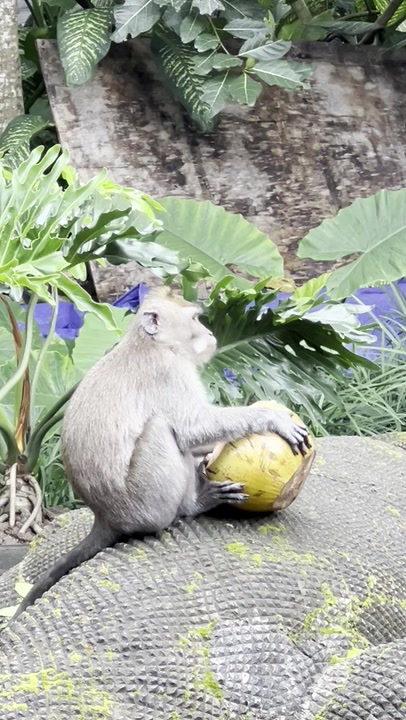
Macaca fascicularis is a relatively slender macaque with a long, narrow tail, which is usually considerably longer than the head and body. Adults have grayish-brown to olive-brown fur, with paler underparts and a darker crown. The face is relatively short, while the muzzle and cheek region can become more pronounced in adults. Males are generally larger and more robust than females and possess prominent canine teeth.
The long tail is one of the species’ most conspicuous features and distinguishes it from several short-tailed or nearly tailless macaques. The tail is useful for balance during climbing and movement through vegetation. Although strongly arboreal in many circumstances, these macaques are also comfortable traveling and foraging on the ground.
The species occupies an exceptionally broad variety of habitats. It occurs in lowland rainforest, secondary forest, mangroves, river margins, coastal vegetation, plantations, agricultural landscapes, and areas around human settlements. It is particularly associated with environments containing reliable water and food resources. Its distribution extends from southern Indochina and Myanmar through Malaysia and Indonesia to the Philippines, with additional populations in the Nicobar Islands.
Despite the traditional common name crab-eating macaque, crabs are only one component of a highly varied diet. M. fascicularis feeds on fruits, seeds, leaves, flowers, insects, crustaceans, eggs, and other small animal foods. Populations living near rivers, estuaries, and mangroves may exploit aquatic and intertidal resources, while forest populations rely heavily on fruits and other plant material.
The species is primarily diurnal. It is an agile climber and can move rapidly through branches, but it also spends substantial periods on the ground. Long-tailed macaques are capable swimmers and may enter water while traveling or foraging. Their combination of climbing, terrestrial movement, and swimming allows them to exploit a remarkably broad range of environments.
Long-tailed macaques are highly social primates. They generally live in multi-male, multi-female groups containing adults, juveniles, and infants. Females commonly remain in their natal groups, creating networks of related females. Grooming is an important social activity, while vocalizations, facial expressions, body postures, and physical contact are used in maintaining relationships and resolving conflicts.
Group members establish dominance relationships that can influence access to food, resting places, and reproductive opportunities. Adult males may transfer between groups, while females often maintain long-term relationships with maternal relatives. Young macaques spend considerable time playing with one another, providing opportunities to develop locomotor skills, feeding techniques, and social behavior.
Reproduction generally results in a single infant after a prolonged gestation. Infants are carried and nursed by their mothers and gradually become more independent as they develop. Maternal relationships are particularly important in the species’ social structure, and young animals learn many aspects of their behavior by observing and interacting with older group members.
The species is also notable for its close association with humans. Long-tailed macaques can exploit farmland, plantations, tourist sites, temples, villages, and urban environments, especially where food is readily available. This adaptability can bring them into conflict with people through crop feeding, property damage, food theft, and other interactions. Human feeding can further alter their natural behavior and social dynamics.
Ecologically, M. fascicularis functions as both a fruit consumer and seed disperser, while its consumption of insects, crustaceans, and other small animals places it at several levels of the food web. In mangrove and coastal environments, its feeding activities connect terrestrial forest resources with intertidal food sources. The species itself can serve as prey for large predators where they coexist.
Conservation concerns have increased because of habitat loss, fragmentation, hunting, capture, persecution, and exploitation for research and other uses. Its ability to live in disturbed environments has allowed some populations to persist despite extensive landscape change, but this does not eliminate threats to wild populations. The current Mammal Diversity Database records the species as Endangered under the IUCN assessment.
The long-tailed macaque is therefore an important example of an adaptable Southeast Asian primate. Its combination of long-tailed morphology, flexible diet, strong social organization, climbing and swimming abilities, and tolerance of diverse habitats has enabled it to occupy one of the broadest ecological ranges among macaques. At the same time, its increasingly complex interactions with humans make conservation and responsible management particularly important.