

Burning Blister Beetles (Genus Epicauta)
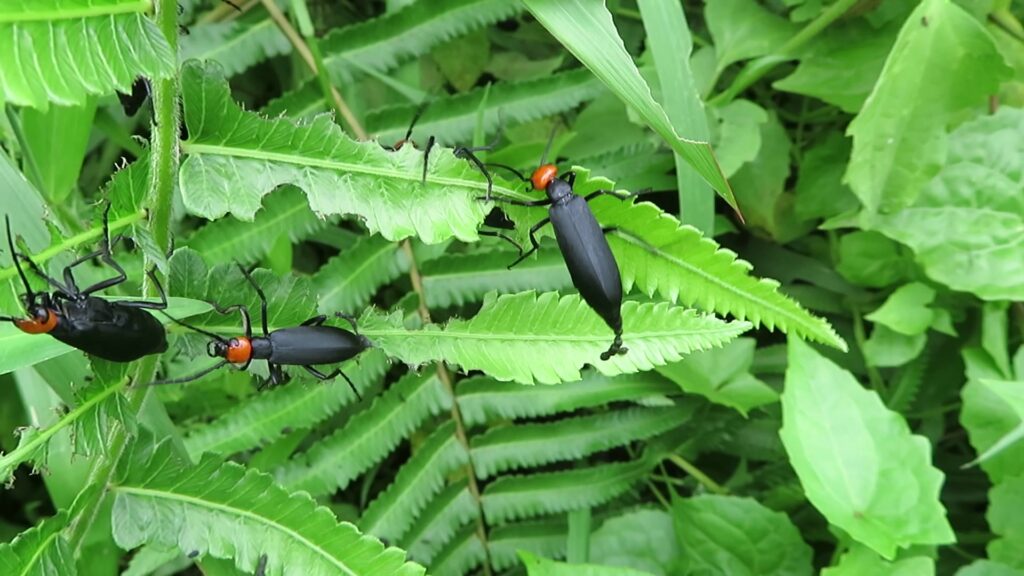
The genus Epicauta comprises a large and widely distributed group of blister beetles belonging to the family Meloidae and subfamily Meloinae. These beetles are found in many parts of the world, particularly in warm and temperate regions, where they inhabit grasslands, open woodlands, agricultural fields, scrublands, and other environments with abundant vegetation. Members of Epicauta are known for their elongated bodies, relatively soft wing covers, plant-feeding habits, and chemical defences involving cantharidin. Some species are important agricultural pests because adults can feed on leaves, flowers, and other plant tissues, sometimes causing substantial damage when they occur in large numbers.
Adult Epicauta beetles generally have elongated, narrow bodies with a distinct head, a relatively slender pronotum, and long elytra that cover most of the abdomen. Their bodies are often soft compared with those of beetles possessing heavily hardened wing covers. Many species are black, dark brown, grey, or greyish black, while others display pale hairs, stripes, or contrasting markings. Some have a dull, velvety appearance, whereas others are slightly glossy. Body size and proportions vary among species, and external coloration alone is not always sufficient for reliable identification.
The head bears prominent compound eyes, segmented antennae, and chewing mouthparts adapted for feeding on plant material. Antennal shape and length differ among species and can be important taxonomic characteristics. The thorax supports three pairs of legs and two pairs of wings, with the forewings modified into elytra. These elytra are typically elongated and may be relatively flexible, reflecting the characteristic body structure of blister beetles. The legs enable adults to walk across foliage and soil, while the membranous hindwings allow many species to fly between feeding sites and suitable habitats.
The genus Epicauta has a broad geographic distribution, with species occurring across parts of the Americas, Europe, Africa, and Asia. Individual species occupy different ranges and may be associated with particular climatic conditions or vegetation types. Many are encountered in open habitats where herbaceous plants are abundant, including grasslands, pastures, field margins, and cultivated landscapes. Some species thrive in agricultural environments because crops provide readily available food, while others occur mainly in natural or semi-natural habitats. Their abundance is influenced by temperature, rainfall, soil conditions, plant availability, and seasonal changes in vegetation.
Adult Epicauta are primarily herbivorous and feed on leaves, flowers, buds, and other above-ground plant tissues. Their host preferences vary among species. Some feed on a wide range of plants, while others show stronger preferences for particular plant families or crop species. When populations are small, feeding damage may be limited, but large aggregations can rapidly consume foliage and damage flowers or reproductive structures. Several species have been recorded as pests of crops such as legumes, alfalfa, potatoes, and other cultivated plants. Their economic significance depends on the species, the crop involved, the timing of infestation, and the number of beetles present.
The life cycle of Epicauta is notable for its complex larval development, a process known as hypermetamorphosis. During this process, successive larval stages differ considerably in their appearance and behaviour. The earliest larva, called a triungulin, is typically active and mobile, with well-developed legs that help it locate a suitable food source. Later larval stages become less mobile and are adapted for feeding and growth. This developmental pattern is characteristic of many blister beetles and reflects the specialized ecological requirements of their immature stages.
In many species of Epicauta, larval development is associated with the nests of solitary bees. The mobile first-stage larvae may locate a bee nest, where they can feed on eggs, immature bees, or stored provisions. This relationship can affect the reproductive success of their hosts, although its intensity depends on the beetle species and the availability of suitable nests. Not all details of larval ecology are equally well documented across the genus, and host associations should be confirmed for individual species rather than assumed to be universal. The dependence of many species on particular host resources makes their early development a vulnerable stage of the life cycle.
Reproduction generally involves mating between adults, followed by the deposition of eggs in soil or other suitable locations. Females may lay large numbers of eggs, compensating for the high mortality experienced by larvae that fail to find appropriate hosts or resources. Hatching and development are influenced by temperature, soil moisture, rainfall, and the availability of suitable food sources. Adult emergence often coincides with favourable seasonal conditions and the growth of host plants. Depending on the species and climate, the life cycle may take several weeks to months or longer to complete.
One of the most important characteristics of Epicauta is its chemical defence. Like many other blister beetles, members of this genus produce or accumulate cantharidin, a potent substance that can cause blistering and irritation when it contacts human skin. If ingested, cantharidin can cause severe poisoning and may be life-threatening. The compound helps deter predators and is an important feature of the beetles’ defensive biology. Some species have dark or contrasting coloration that may act as a warning signal. Because the concentration of cantharidin can vary, beetles should not be crushed or handled with bare hands, and they should never be consumed.
Ecologically, Epicauta participates in interactions involving plants, bees, predators, and other organisms. Adults influence plant communities through feeding, while larvae of species associated with bee nests can affect populations of solitary pollinators. Blister beetles also form part of terrestrial food webs, although their chemical defences discourage many potential predators. Their abundance may fluctuate substantially with seasonal weather, plant growth, and the availability of larval hosts. In agricultural landscapes, monitoring adult populations can help identify periods when feeding damage may become economically important.
The taxonomy of Epicauta relies on several morphological characteristics, including antennal structure, pronotum shape, elytral proportions, surface sculpturing, leg features, and reproductive anatomy. Closely related species may appear similar externally, making detailed examination necessary for accurate identification. Larval characteristics, host associations, geographic distribution, and molecular evidence can provide additional information. As research on blister beetle diversity continues, relationships among species and the boundaries of certain taxonomic groups may be revised.
Overall, Epicauta is a distinctive genus of blister beetles characterized by its elongated body, plant-feeding adults, complex larval development, and potent chemical defence. Its members occupy a wide range of habitats and contribute to ecological interactions involving vegetation and other insects. Although some species can cause considerable agricultural damage, they are also part of the natural diversity of terrestrial ecosystems. Understanding their life cycles, host relationships, and defensive chemistry is important for accurate identification, ecological research, and the safe management of species that affect cultivated plants.