

Tribe Epicautini
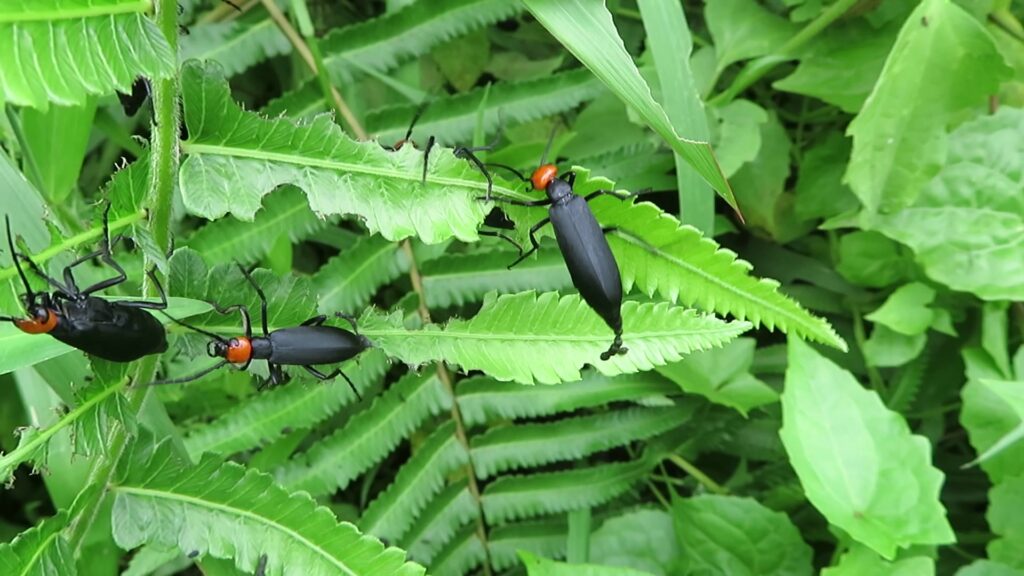
The tribe Epicautini is a taxonomic group of blister beetles belonging to the family Meloidae and subfamily Meloinae. Its members are part of a beetle lineage known for their soft-bodied forms, specialized chemical defences, and often complex larval development. The tribe includes the genus Epicauta, one of the best-known genera of blister beetles, as well as related taxa recognized in particular classifications. Epicautine beetles occur in various terrestrial habitats, especially open environments where flowering plants and suitable larval hosts are available. Their biology reflects the distinctive life-history strategies of meloid beetles, whose adults often feed on vegetation while their larvae may depend on the nests of other insects.
Members of Epicautini generally have elongated, relatively soft bodies, a distinct head, a narrow or moderately constricted pronotum, and flexible elytra covering most of the abdomen. Their coloration is commonly dark, including black, brown, or grey, although some species have contrasting markings, pale hairs, or other distinctive surface patterns. The body may appear dull or slightly glossy, depending on the species and the density of its surface covering. These characteristics can help distinguish epicautine beetles from other blister beetles, although accurate identification often requires examination of antennal structure, body proportions, surface sculpturing, and reproductive anatomy.
The head bears compound eyes, segmented antennae, and chewing mouthparts suited to feeding on plant tissues. Antennae vary in length and shape among species and are important in recognizing related genera. The thorax supports three pairs of legs and two pairs of wings, with the forewings modified into elytra. In many members of the tribe, the elytra are elongated and relatively flexible compared with those of beetles with heavily hardened wing covers. The legs allow adults to move across vegetation and soil, while the wings enable many species to disperse between feeding sites and suitable habitats.
Epicautini is associated with a range of terrestrial environments, including grasslands, agricultural fields, open woodland, scrub, and other landscapes with abundant herbaceous vegetation. Members may be encountered on leaves, stems, flowers, and crops, particularly during periods of active growth. Their distribution depends on climate, vegetation, soil conditions, and the presence of appropriate hosts for larval development. Some species occupy broad geographic ranges, while others are more restricted. Agricultural and disturbed landscapes can provide suitable resources for certain species, although intensive land management and pesticide use may also affect their populations.
Adult epicautine beetles are primarily plant feeders. Depending on the species, they may consume leaves, flowers, buds, or other plant tissues. Some are known to feed on a wide range of plants, while others show stronger preferences for particular host groups. When beetles occur in large numbers, their feeding may cause visible damage to foliage and reproductive structures, making certain species economically significant agricultural pests. However, their impact varies substantially among species and environmental settings, and the presence of an epicautine beetle does not automatically indicate a serious plant-health problem.
The larval development of Epicautini follows the characteristic pattern of many blister beetles, often involving hypermetamorphosis, in which successive larval stages differ markedly in appearance and behaviour. Early larvae are typically active and mobile, while later stages become more specialized for feeding and growth. In many well-studied species of Epicauta, the early larvae seek out the nests of solitary bees, where they may consume bee eggs, immature stages, or stored provisions. However, the precise host relationships and developmental requirements are species-specific, and details should not be assumed to be identical across the entire tribe.
Reproduction involves mating between adults, followed by egg laying in suitable sites, often in soil. Females may produce numerous eggs, compensating for the high mortality associated with the demanding larval stage. After hatching, the young larvae must locate the appropriate resources needed to complete development. Temperature, rainfall, soil moisture, host availability, and seasonal plant growth can all influence reproductive success. Depending on the species and environmental conditions, development may proceed over several weeks or months, and some species may exhibit seasonal patterns of emergence that correspond with the availability of adult food plants and larval hosts.
Chemical defence is a major feature of Epicautini and other blister beetles. Many members of the family Meloidae produce or accumulate cantharidin, a potent compound that can cause blistering when it contacts human skin and can be toxic if swallowed. This defence helps deter predators and may be associated with warning coloration or other avoidance behaviours. Beetles should not be crushed or handled with bare hands, particularly when identification is uncertain. The presence and concentration of cantharidin can vary among species and individuals, but blister beetles should generally be treated as chemically defended insects.
Ecologically, Epicautini participates in several important relationships involving plants, bees, predators, and other organisms. Adults influence vegetation through feeding, while larvae of species that depend on bee nests may affect the reproductive success of their hosts. At the same time, blister beetles form part of terrestrial food webs and may be attacked by predators capable of tolerating or avoiding their chemical defences. Their abundance is shaped by the availability of host plants, nesting insects, climatic conditions, and habitat management. Changes in wild bee populations and the loss of suitable nesting habitats may therefore affect some epicautine species indirectly.
The classification of Epicautini is based on morphological characteristics and its evolutionary relationships within Meloinae. Antennal form, pronotum shape, elytral structure, leg morphology, and reproductive anatomy can all contribute to taxonomic identification. Molecular research has also helped clarify relationships among blister beetle lineages, although the classification of some groups continues to vary among taxonomic treatments. Because tribal boundaries and genus assignments can change as new evidence becomes available, the exact composition of Epicautini should be interpreted according to the taxonomic authority being followed.
Overall, Epicautini represents a group of blister beetles distinguished by the characteristic body structure, chemical defence, and specialized development associated with Meloinae. Its members occupy a variety of open and vegetated habitats, where adults interact with plants and larvae may depend on other insects. Some species can become agricultural pests, while others remain less conspicuous components of natural ecosystems. Understanding their taxonomy, host relationships, and life cycles is essential for appreciating their ecological roles and managing encounters with these chemically defended beetles.