Bali Wildlife
Every Spices Matter


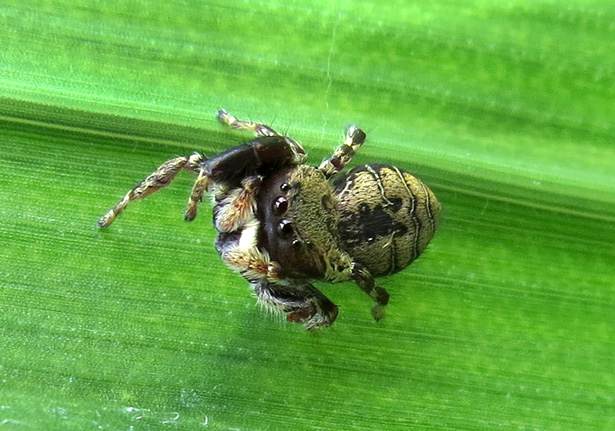
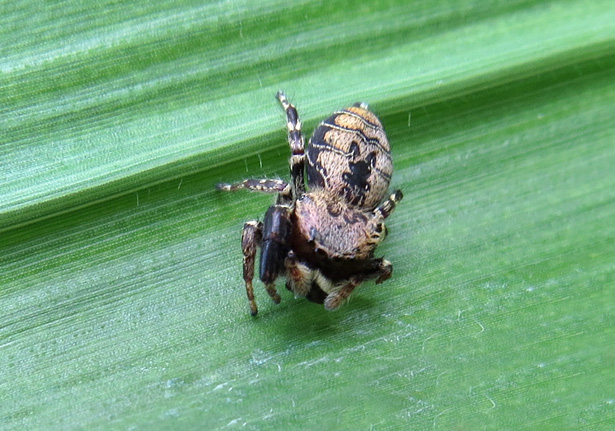
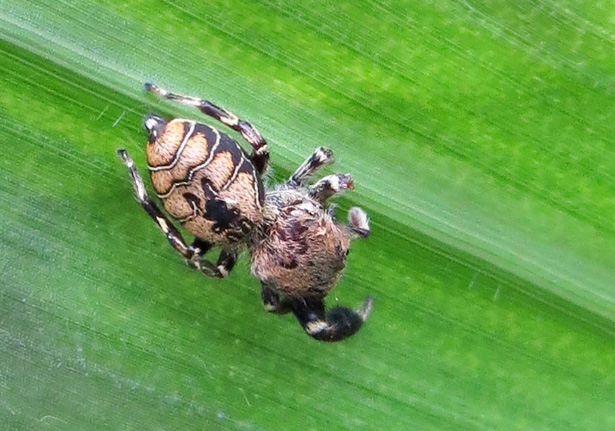
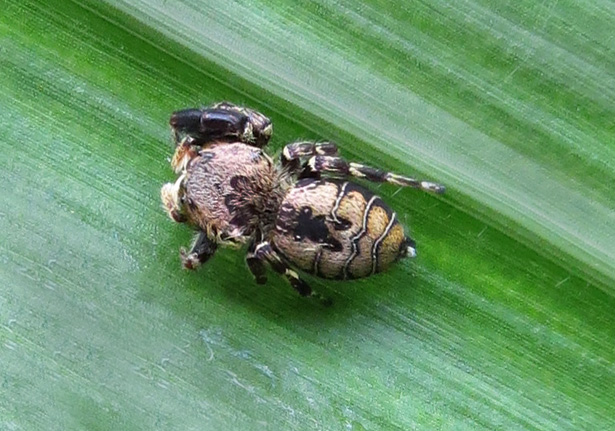
Dendryphantina is a subtribe within the tribe Dendryphantini of the family Salticidae (Order Araneae, Suborder Araneomorphae). It represents a central lineage of jumping spiders, with the greatest diversity in the New World, particularly in tropical and subtropical regions of the Americas.
Members of Dendryphantina are diurnal, visually driven hunters that rely on acute vision and agile jumping to capture prey. They do not construct prey-capture webs, instead stalking and leaping onto prey with precision. Species occur in a wide range of habitats, including forests, shrublands, grasslands, tree trunks, foliage, and human-modified environments.
Morphologically, spiders of this subtribe are typically small to medium-sized with compact bodies and relatively robust legs adapted for jumping. The anterior median eyes are large and forward-facing, providing high-resolution vision essential for prey detection and complex visual communication. Coloration varies from cryptic browns and grays to vividly patterned forms with iridescent or metallic scales, especially in males.
Male genitalia show characteristic palpal structures that define Dendryphantina, particularly in the configuration of the embolus and tegulum. Females possess fully developed entelegyne genitalia, with well-defined epigynes and internal duct systems that are species- and genus-specific.
Behaviorally, Dendryphantina species are notable for elaborate courtship displays, often involving coordinated leg movements, body posturing, and rhythmic motions directed toward females. These displays are visually oriented and play a critical role in mate recognition and reproductive isolation.
Ecologically, members of Dendryphantina are effective predators of small insects and other arthropods, contributing to natural pest regulation across diverse ecosystems. The subtribe represents a successful and diverse radiation of jumping spiders characterized by advanced visual systems, complex behaviors, and broad ecological adaptability.