

Froghoppers (Family Cercopidae)
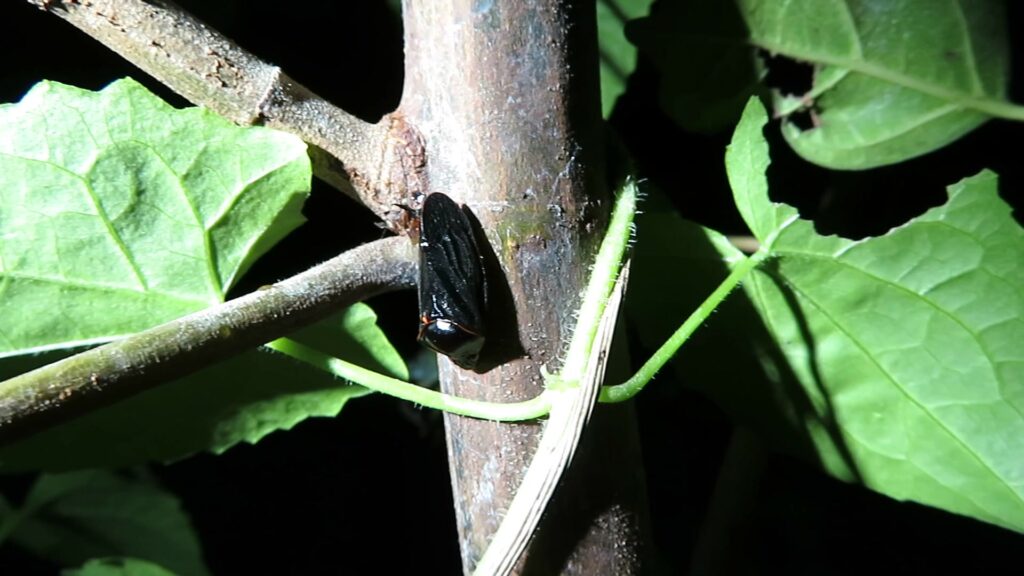
Family Cercopidae is a family of sap-feeding insects belonging to the superfamily Cercopoidea within the order Hemiptera. Commonly known as froghoppers or spittlebugs, these insects are distributed worldwide, with considerable diversity in tropical and subtropical regions. They inhabit a variety of terrestrial environments, including grasslands, forests, agricultural fields, meadows, and gardens, where suitable host plants provide food and shelter. Adult cercopids typically have compact, often robust bodies, short antennae, and strong hind legs adapted for powerful jumping. Their wings are generally held roof-like over the abdomen when at rest, and their coloration varies among species, ranging from brown, gray, and black to bright red, orange, yellow, and green, sometimes with contrasting spots or bands. One of the family’s most distinctive characteristics is the behavior of its nymphs, which produce protective masses of frothy fluid commonly called spittle. This foam forms when excreted liquid is mixed with air and helps protect the developing insects from predators, desiccation, and temperature fluctuations. Both nymphs and adults feed on plant xylem sap using specialized piercing-sucking mouthparts. Nymphs generally remain close to the ground or on host plants, while adults can move between plants by jumping or flying. Their life cycle typically includes eggs, several nymphal stages, and winged adults, with development influenced by temperature, moisture, and host-plant availability. Most species are associated with grasses, herbs, shrubs, or trees, depending on their ecological specialization. Although cercopids are important components of natural food webs, some species can become agricultural pests when abundant, particularly in grasslands and plantations, where sap feeding may reduce plant vigor. Certain species are also associated with the transmission of plant pathogens, including bacteria responsible for diseases in particular crops. Through their feeding activity, distinctive nymphal foam production, and interactions with vegetation, Cercopidae represents an ecologically significant family of insects in terrestrial ecosystems.