

Giant Land Snails (Family Achatinidae)
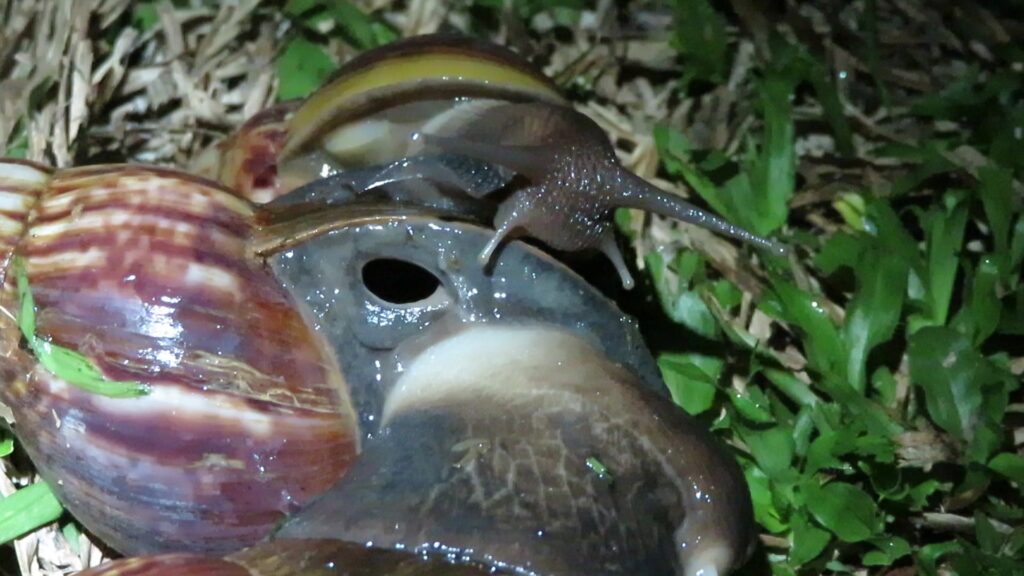
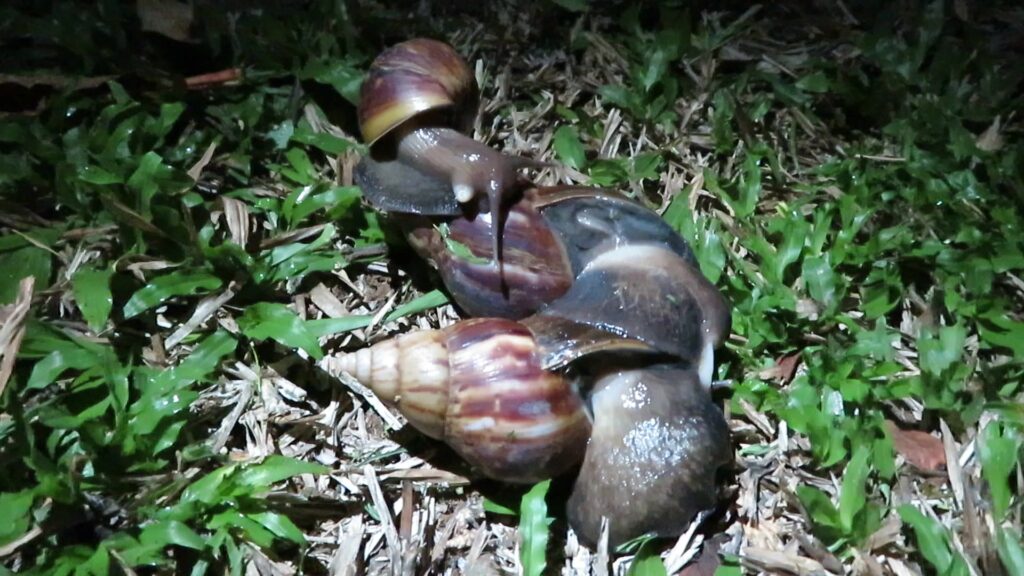
The family Achatinidae comprises a group of terrestrial gastropod mollusks commonly known as giant African land snails and their relatives. They belong to the class Gastropoda, order Stylommatophora, and superfamily Achatinoidea. The family includes some of the largest land snails in the world, notable for their elongated shells, substantial body size, and adaptability to a variety of terrestrial environments. Among its best-known members is the giant African land snail, Lissachatina fulica, which has become widely distributed beyond its native range.
Members of Achatinidae typically possess a long, spirally coiled shell that is often conical or oval-conical in shape. Shell coloration varies among species and may include shades of brown, cream, yellow, and reddish brown, frequently arranged in stripes or mottled patterns. The shell provides protection from predators, physical injury, and periods of unfavorable environmental conditions. Shell size, shape, and surface markings differ between species and can help with identification, although these features may overlap among closely related forms.
Like other land snails, achatinids have a soft, muscular foot used for locomotion. They move by producing mucus that reduces friction as the foot contracts in waves over the substrate. Their head bears two pairs of tentacles: the longer upper pair carries the eyes at its tips, while the shorter lower pair functions primarily in chemical and tactile sensing. These sensory structures help the animals locate food, detect environmental conditions, and navigate their surroundings.
Achatinidae are native primarily to tropical and subtropical Africa, where species inhabit forests, woodland edges, shrublands, grasslands, and other environments with suitable moisture and food resources. Many are especially active in humid conditions and seek shelter during dry or hot periods. They may hide beneath leaf litter, fallen logs, stones, vegetation, or within crevices, reducing water loss and avoiding direct exposure to sunlight. Some species have adapted readily to disturbed habitats, gardens, farms, and urban areas.
Most achatinids are herbivorous or broadly detritivorous, feeding on living plant material, fallen leaves, decaying vegetation, algae, fungi, and other organic matter. Their mouth contains a radula, a ribbon-like structure equipped with numerous tiny teeth used to scrape and process food. Feeding habits vary with species, age, habitat, and food availability. By consuming decaying organic material, these snails can contribute to decomposition and nutrient cycling, although species that feed heavily on crops and ornamental plants may become agricultural or horticultural pests.
Reproduction in Achatinidae generally involves simultaneous hermaphroditism, meaning that an individual possesses both male and female reproductive organs. Many species can mate with another individual, exchange sperm, and subsequently lay eggs in moist soil or sheltered locations. Some larger species produce substantial clutches, and their eggs and young may survive in suitable conditions around human settlements. Growth rate, age at maturity, egg production, and lifespan vary among species and are influenced by temperature, moisture, food supply, and other environmental factors.
Achatinids are ecologically important as consumers of vegetation and decomposing material, and they also serve as prey for various animals. However, some species can have considerable negative effects when introduced outside their native ranges. Lissachatina fulica, in particular, has become an invasive species in many tropical and subtropical regions. It can damage agricultural crops and garden plants, compete with native land snails, and alter local ecological interactions. In addition, introduced populations may create public-health concerns because the species can act as a host for certain parasites under suitable conditions.
The family also presents challenges for taxonomy and species identification. Shell form and coloration can vary within a species, while superficially similar species may require examination of anatomical features or genetic evidence to distinguish them reliably. Scientific classifications and generic placements have changed over time, so names used in older literature may differ from those accepted in more recent taxonomic treatments.
Conservation concerns within Achatinidae are not uniform. Some species can thrive in disturbed habitats and spread rapidly, whereas others may have restricted distributions and face pressure from habitat destruction, pollution, collection, or competition with introduced species. Effective management therefore requires distinguishing native species of conservation concern from invasive species that may need control.
Overall, Achatinidae is a diverse family of land snails distinguished by its often large size, elongated shells, specialized terrestrial adaptations, and ecological importance. Its members illustrate both the ability of land mollusks to thrive in warm environments and the consequences that can arise when adaptable species are transported beyond their natural ranges.